Introduction
When money is short and a bill cannot wait, a payday loan can look like a quick answer. You borrow a small amount now, then repay it when your next paycheck or income payment arrives.
The problem is cost. Payday loans are usually short-term, high-cost loans, and the repayment can take a big bite out of your next check. If that leaves you short again, one loan can turn into repeat borrowing.
This guide explains what a payday loan is, how it works, what it can cost, why it can be risky, and what to check before borrowing. It also covers safer alternatives to consider first.
Key Takeaways
- A payday loan is usually a small, short-term loan meant to be repaid around your next payday.
- Payday loans are often easy to access, but easy approval does not always mean easy repayment.
- The fee may look small at first, but the cost can be high because the repayment window is short.
- Many payday loans require access to your bank account or a postdated check for repayment.
- The biggest risk is repeat borrowing if the loan payment leaves you short again.
- Payday loan rules vary by state, so availability, costs, and repayment terms can differ.
- Before using a payday loan, compare safer options like payment plans, credit union loans, Payday Alternative Loans, or local assistance.
Disclaimer: This site contains affiliate links. If you make a purchase, we may earn a commission at no extra cost to you.
What a Payday Loan Actually Is
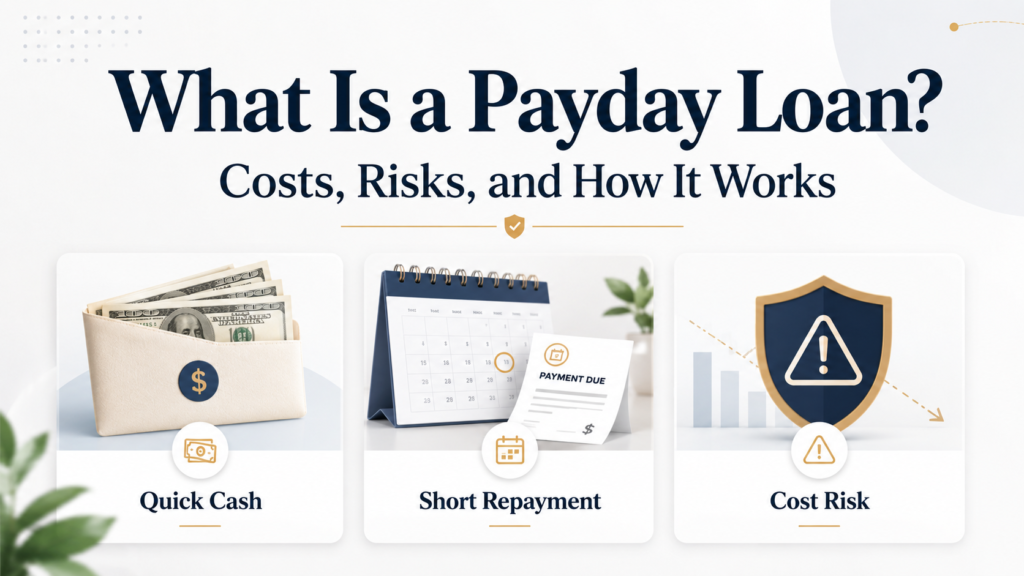
A payday loan is a small, short-term loan that is usually meant to cover a cash gap until your next paycheck or income payment. People often use payday loans for urgent bills, car repairs, groceries, rent gaps, or other expenses that cannot wait.
The loan amount is usually smaller than a personal loan, but the cost can be much higher. Instead of focusing on a long repayment plan, a payday loan is often built around quick access and fast repayment.
In plain terms, a payday loan works like this: you borrow money now, pay a fee for the loan, and repay the full amount soon after. That repayment may come from your next paycheck, a bank withdrawal, or another repayment method the lender requires.
Payday loans can feel simple because they are often easy to apply for. Some lenders may focus more on your income and bank account than your credit score.
But simple does not always mean safe. Before using one, you need to understand the full repayment amount, the due date, and what happens if you cannot pay on time.
How Payday Loans Work
A payday loan usually starts with a short application online or at a storefront lender. The lender asks for basic information, such as your income, identification, and bank account details.
If approved, you receive the money quickly. Depending on the lender, the funds may come as cash, a bank deposit, a check, or a prepaid card.
In return, you agree to repay the amount you borrowed plus fees. The repayment date is often tied to your next payday or next income payment.
The lender may collect repayment through:
- An electronic withdrawal from your bank account
- A postdated check
- A debit card payment
- Another payment method listed in the loan agreement
This is why the due date matters so much. If the payment comes out before you have enough money in your account, you could face extra fees from the lender, your bank, or both.
Before accepting a payday loan, make sure you know exactly when repayment is due, how the lender will collect it, and how much money will leave your account.
What Payday Loans Cost
Payday loans can look cheap at first because the cost is often shown as a fee instead of a regular interest rate. For example, a lender may charge a set fee for every $100 you borrow.
That fee can feel small when you are focused on getting cash quickly. But the loan is usually due in a short time, so the cost can be much higher than it looks.
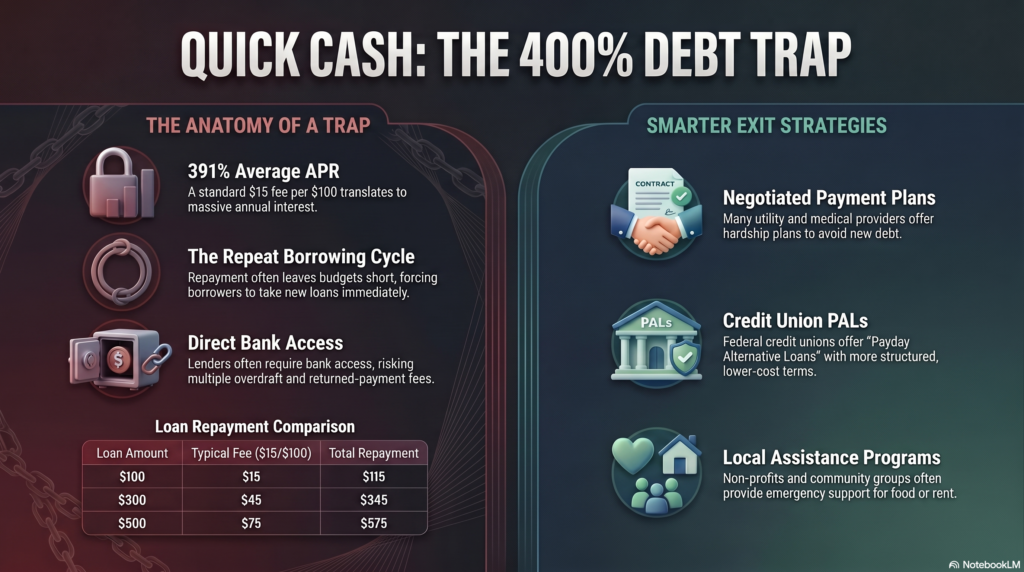
The Federal Trade Commission says payday lenders often charge $10 to $30 for every $100 borrowed. It also gives this example: a $15 fee for every $100 on a two-week payday loan equals an APR of 391%.
Here is the plain-English version: if you borrow $500 and the fee is $15 per $100, the fee would be $75. That means you would owe $575 when the loan is due.
The hard part is not only the fee. The hard part is paying the full amount back so quickly. If that $575 comes out of your next paycheck and leaves you short for rent, groceries, gas, or utilities, you may feel forced to borrow again.
Before taking a payday loan, ask:
- How much will I receive?
- How much will I owe in total?
- When is the full payment due?
- What fees apply if I cannot pay on time?
- Will this leave me short again after my next paycheck?
The real cost of a payday loan is not just the fee. It is the pressure that fee creates when repayment is due.

Why Payday Loans Can Be Risky
Payday loans can be risky because they are usually built around fast repayment. That can be a problem when your next paycheck already has a job to do.
Most people do not borrow because they have extra room in the budget. They borrow because money is already tight. So when the full loan payment and fees come due, that repayment can crowd out rent, groceries, gas, utilities, or other basic bills.
That is how repeat borrowing can start. You take one payday loan to cover today’s emergency. Then the repayment leaves you short again. Then another loan starts to look like the only way to get through the next week.
The risk is not only the loan amount. It is the timing.
Payday loans can also create problems if the lender has access to your bank account. If the withdrawal hits when your balance is too low, you may face fees from your bank, the lender, or both.
A payday loan may feel like relief at first, but it can add pressure quickly if:
- The full payment is due before your budget recovers.
- The fees take more from your paycheck than expected.
- You need to borrow again after repayment.
- A bank withdrawal causes overdraft fees.
- You do not have a clear plan for the next round of bills.
Before using a payday loan, ask yourself what happens after repayment. If paying it back creates another cash shortage, the loan may not solve the problem. It may only move the problem to your next payday.
Who Usually Qualifies for a Payday Loan
Payday loan requirements vary by lender and by state, but many lenders focus on income and repayment access more than traditional credit approval.
That does not mean approval is guaranteed. It means the lender usually wants to see that you have money coming in and a way to collect repayment.
You may need to provide:
- A government-issued ID
- Proof of income
- An active checking account
- A phone number or email address
- Proof that you meet the minimum age requirement in your state
Some payday lenders may not require a traditional credit check. Others may review your borrowing history, income, bank activity, or past payday loan use.
State rules also matter. Some states limit payday loans, restrict fees, or do not allow them. That means the loan amount, cost, repayment terms, and availability can change depending on where you live.
Even if you qualify, pause before borrowing. The better question is not just, “Can I get approved?” It is, “Can I repay this without falling behind on everything else?”
Payday Loans vs. Other Short-Term Cash Options
A payday loan is only one way to handle a cash shortage. It may be fast, but it is not always the safest or lowest-cost option.
Before borrowing, compare it with other choices that may give you more time, clearer terms, or less pressure on your next paycheck.
| Option | Best For | Main Advantage | Main Risk |
|---|---|---|---|
| Payday loan | Fast cash when few options are available | Quick access to small amounts | High fees and short repayment window |
| Payday Alternative Loan | Federal credit union members | More structured terms than many payday loans | Not available at every credit union |
| Cash advance app | Small gaps before payday | Fast access to a small amount | Fees and repayment may shrink your next paycheck |
| Payment plan | Bills, medical costs, utilities, or service balances | May help you avoid borrowing | Requires approval from the provider |
| Personal loan | Larger expenses that need more time | Longer repayment schedule | Credit, income, and approval requirements |
The best choice depends on what you need the money for, how fast you need it, and how repayment will affect your next paycheck.
If the problem is a bill, ask for a payment plan before borrowing. If you already belong to a credit union, ask about small-dollar loans or Payday Alternative Loans. If you only need a small amount for a few days, compare the cost of a cash advance app carefully.
A payday loan may feel like the fastest answer, but fast does not always mean better. The safer option is the one that solves the problem without creating another cash shortage when repayment is due.
When a Payday Loan Might Seem Like the Only Option
A payday loan can start to look like the only choice when the need is urgent and other doors feel closed. Maybe your credit is poor, your savings are gone, or the bill cannot wait until your next paycheck.
That pressure is real. People often consider payday loans when they are trying to keep the lights on, avoid a late fee, fix a car, cover groceries, or handle an unexpected expense.
The problem is that urgency can make a costly loan feel safer than it is. When you are focused on today’s bill, it is easy to overlook what the repayment will do to next week’s budget.
Before assuming a payday loan is your only option, pause and check for one less expensive path. You may be able to:
- Ask for a bill extension
- Set up a payment plan
- Contact a credit union
- Ask your employer about a paycheck advance
- Use a local assistance program
- Borrow a smaller amount from someone you trust
- Delay a nonessential expense
A payday loan may feel simple because it moves fast. But a slower option can be better if it gives you more time, lower costs, or a payment plan that does not drain your next paycheck.
If you still choose a payday loan, go in with clear numbers. Know the total repayment amount, the due date, and whether you can cover your regular bills after paying it back.

What to Check Before Taking a Payday Loan
Before taking a payday loan, slow the decision down long enough to understand the full cost. The lender may focus on how fast you can get the money, but your focus should be what happens when repayment is due.
Start with the total repayment amount. This is the amount you borrowed plus all fees. If you borrow $300, you need to know the exact dollar amount you will owe, not just the fee per $100.
Next, check the due date. A payday loan can become stressful if the payment comes due before your budget has recovered. Make sure you know whether repayment is due on your next payday, your next income date, or another specific date.
You should also know how the lender will collect repayment. If the lender can withdraw money from your bank account, make sure the timing will not cause overdraft fees or missed payments on other bills.
Before signing, ask:
- How much money will I receive?
- How much will I owe in total?
- When is the payment due?
- How will the lender collect repayment?
- What happens if I cannot pay on time?
- Are there late fees, rollover fees, or returned-payment fees?
- Will this payment leave me short for rent, groceries, gas, or utilities?
If you cannot answer these questions clearly, do not rush into the loan. A payday loan should never be a mystery. The cost, due date, and repayment method should be clear before you agree.
Payday Loan Alternatives to Consider First
Before using a payday loan, check whether another option can solve the problem with less cost or more time to repay. The best alternative depends on what the money is for.
If the problem is a bill, start with the company you owe. If the problem is a short cash gap, check lower-cost borrowing options before choosing a payday lender.
Bill Extensions or Payment Plans
If you are behind on a utility bill, medical bill, phone bill, rent payment, or service balance, ask for more time before borrowing.
Many companies would rather set up a payment plan than send the account to collections or shut off service.
Ask for:
- A new due date
- A partial payment option
- A hardship plan
- A written payment agreement
- Any late fees or service risks
This option can help you avoid a loan completely.
Credit Union Loans
Credit unions may offer small personal loans, emergency loans, or other short-term borrowing options. These loans may give you clearer terms and more time to repay than a payday loan.
This can be a good place to start if you already belong to a credit union. If you do not, ask whether you qualify for membership.
Payday Alternative Loans
Payday Alternative Loans, also called PALs, are small loans offered by some federal credit unions. They are designed as an alternative to traditional payday loans.
A PAL may help if you need a smaller loan, want scheduled payments, and can qualify through a participating credit union.
Not every credit union offers PALs, so ask directly before you count on this option.
Employer Advances or Earned Wage Access
Some employers let workers access part of their earned wages before payday. This may be offered through payroll, HR, or an earned wage access provider.
This can help with a small gap, but it still reduces the money available on your next paycheck.
Before using it, ask:
- Is there a fee?
- How fast can I receive the money?
- How will repayment happen?
- Will my next paycheck still cover regular bills?
Local Assistance Programs
If the need involves rent, food, utilities, transportation, or medical costs, local help may be available. Nonprofits, churches, community groups, and government programs may offer emergency support.
This option may take more effort, but it can reduce how much you need to borrow or help you avoid borrowing altogether.
Borrowing From Friends or Family
Borrowing from someone you trust may cost less than a payday loan. The risk is personal, not just financial.
Keep the agreement clear. Write down the amount, repayment date, and how you will pay it back. A simple plan can prevent confusion later.
Cash Advance Apps
Cash advance apps may help with a small cash gap before payday. They can be fast, but they are not always free.
Watch for fees, tips, subscriptions, and instant-transfer charges. Also check when repayment will come out of your account.
A cash advance app may help once in a while. It becomes risky if you need it every paycheck.
Personal Loans
A personal loan may make sense for a larger expense that needs more time to repay. It may offer fixed payments and a clearer payoff date.
Before applying, check the APR, fees, repayment term, and total cost. If possible, use prequalification to compare offers before a hard credit check.
The best alternative is the one that solves the urgent need without making the next paycheck harder to manage. Start with no-debt options first, then move to the lowest-cost borrowing option if needed.

Common Mistakes to Avoid With Payday Loans
A payday loan can become harder to manage when you focus only on getting approved. Before borrowing, look at what the loan will do to your next paycheck and your regular bills.
Looking Only at the Cash Amount
The amount you receive is not the full story. A $300 loan may feel small, but the fee and short repayment window can make it harder to handle than expected.
Always compare the amount you get with the amount you will owe.
Ignoring the Due Date
The due date matters because payday loans are often repaid quickly. If the payment comes due before your budget has recovered, you may fall behind on other bills.
Before signing, check the exact repayment date and make sure the money will be available.
Forgetting About Fees
Payday loan fees can make the loan much more expensive than it looks at first. Some borrowers focus on the fee per $100 borrowed but forget to calculate the total repayment amount.
Ask for the full dollar amount you will owe, including all fees.
Borrowing More Than You Need
It can be tempting to borrow extra when approval is available. But a larger loan means a larger repayment.
Borrow only what you need to solve the urgent problem. Extra cash today can become extra stress on your next payday.
Letting the Lender Withdraw Without Planning
If the lender pulls repayment from your bank account, timing matters. A withdrawal that hits before your deposit clears can create overdraft fees or missed payments.
Know when the withdrawal will happen and what else is due from the same account.
Rolling Over or Reborrowing
The biggest mistake is using a new payday loan to cover the old one or to fill the gap the repayment created. That can turn one short-term loan into a cycle.
If repayment will leave you short again, look for another option before borrowing. A payment plan, credit union loan, local assistance program, or nonprofit credit counselor may help more than another payday loan.

Simple Example of How a Payday Loan Can Add Up
Imagine you borrow $300 from a payday lender because your car needs a quick repair before you can get to work.
The lender charges $15 for every $100 borrowed. That means the fee is $45.
So the amount due is not just $300. It is:
- $300 borrowed
- $45 fee
- $345 total due
At first, $45 may not sound like a huge fee. The problem is the timing. If the full $345 is due on your next payday, that money has to come out before you pay rent, groceries, gas, utilities, or other bills.
If your paycheck cannot cover everything after the loan is repaid, you may feel forced to borrow again. That is how one payday loan can turn into a cycle.
The lesson is simple: do not only ask, “Can I get the money today?” Also ask, “Can I repay the full amount on time and still cover the rest of my bills?”
Conclusion
A payday loan can offer fast cash, but speed is only one part of the decision. The bigger question is whether you can repay the full amount on time without falling behind again.
Before taking a payday loan, look at the total cost, due date, fees, and repayment method. A loan that seems small today can create pressure if it takes too much from your next paycheck.
If possible, check safer options first. A payment plan, credit union loan, Payday Alternative Loan, employer advance, local assistance program, or personal loan may give you more time, lower costs, or clearer terms.
The goal is not just to cover one urgent expense. The goal is to solve the problem in a way that keeps your next paycheck stable. If a payday loan would leave you short again, it is worth pausing and looking for another path before you borrow.

Frequently Asked Questions About Payday Loans
What is a payday loan in simple terms?
A payday loan is a small, short-term loan that is usually meant to be repaid when you receive your next paycheck or income payment. It can provide fast cash, but the fees and short repayment timeline can make it expensive.
How much can you borrow with a payday loan?
The amount depends on the lender and your state’s rules. Many payday loans are for smaller amounts, often a few hundred dollars, but the limit can vary based on your income, location, and lender policies.
Do payday loans check your credit?
Some payday lenders may not use a traditional credit check. Many focus more on your income, bank account, and ability to repay. That does not mean the loan is risk-free or easy to manage.
How fast can you get a payday loan?
Some payday lenders offer same-day or next-day funding. Speed is one reason people use them, but fast approval should not replace checking the full cost, due date, and repayment method.
Why are payday loans expensive?
Payday loans are expensive because fees can be high compared with the short time you have to repay the loan. A fee that looks small upfront can become costly when the full amount is due within a short window.
What happens if you cannot repay a payday loan?
If you cannot repay on time, you may face extra fees, returned-payment charges, overdraft fees, collection activity, or pressure to renew or reborrow. Contact the lender as early as possible and ask about repayment options.
Are payday loans legal everywhere?
No. Payday loan rules vary by state. Some states allow them, some restrict them, and others do not allow them in the same way. Check your state’s rules before applying.
What are safer alternatives to payday loans?
Safer alternatives may include bill extensions, payment plans, credit union loans, Payday Alternative Loans, employer advances, local assistance programs, borrowing from someone you trust, or a personal loan. The best option is the one that solves the problem without making your next paycheck harder to manage.

1 Comment
Payday Alternative Loans (PALs): How They Work & Who Qualifies - Look Up Loans · May 10, 2026 at 10:51 am
[…] small amounts of money when cash is tight. They are designed to help borrowers avoid traditional payday loans, which can come with high costs, short repayment windows, and repeat borrowing […]