An unsecured personal loan lets you borrow a lump sum without pledging your home, vehicle, savings account, or another asset.
Instead, the lender evaluates your credit history, income, existing debts, and ability to manage the new payment. This can make the process simpler than borrowing against collateral, but it may also result in stricter qualification requirements or higher costs when your financial profile is weaker.
Most unsecured personal loans are repaid through scheduled monthly installments over a defined term. Borrowers commonly use them for debt consolidation, repairs, medical expenses, moving costs, and other one-time needs.
No collateral does not mean no risk.
Missed payments can damage your credit, result in collection activity, and create possible legal consequences. Fees may also reduce the amount you receive even though repayment is based on the full loan principal.
This guide explains how unsecured personal loans work, what lenders review, what they cost, and how to compare offers before borrowing.
Key Takeaways
- Unsecured personal loans do not require a pledged asset and are generally provided as a lump sum repaid through scheduled installments.
- Approval and pricing depend heavily on credit history, income, existing obligations, and repayment capacity.
- The interest rate does not show the full borrowing cost. Compare APR, fees, net proceeds, monthly payments, and total repayment.
- A longer repayment term may reduce the monthly payment while increasing the total interest paid.
- Missed payments may lead to fees, negative credit reporting, collection activity, and possible legal action.
- Approval does not mean the offer is affordable or competitively priced.
- A strong offer provides sufficient net proceeds, a manageable payment, a reasonable total cost, and clear repayment terms.
Disclosure: This site may contain affiliate links. We may receive compensation if you use certain links, at no additional cost to you. Compensation does not determine our editorial conclusions.
What Is an Unsecured Personal Loan?
An unsecured personal loan is a consumer installment loan that does not require collateral.
You borrow a specific amount and repay it through scheduled installments. The agreement generally establishes:
- The loan principal
- The interest rate and APR
- The repayment term
- The monthly payment
- Applicable fees
- Payment due dates
- The consequences of missed payments
The Consumer Financial Protection Bureau defines a personal installment loan as a loan in which the borrower receives money and repays it in fixed amounts called installments.
Many unsecured personal loans have fixed interest rates. A fixed rate usually supports predictable monthly payments, although borrowers should verify whether the rate and payment remain fixed for the entire term.
How It Differs From Other Credit
An unsecured personal loan is not the same as every credit product that lacks collateral.
A credit card provides a revolving limit that can be borrowed, repaid, and reused. A personal line of credit also permits repeated borrowing, usually with payments that change according to the outstanding balance.
An unsecured personal loan normally provides one lump sum with a defined payoff schedule.
That structure may be more appropriate for a known, one-time expense than for costs that continue or change from month to month.
For a broader explanation of installment, revolving, secured, and unsecured products, see our complete guide to personal loans.
How Unsecured Personal Loans Work
The process varies by lender, but most unsecured personal loans follow the same general stages.
Prequalification
Some lenders allow prospective borrowers to review estimated offers before completing a full application.
Prequalification may show:
- Estimated loan amounts
- Potential APRs
- Available repayment terms
- Approximate monthly payments
It is not final approval. The terms may change after the lender verifies the application.
Some prequalification processes use a soft credit inquiry. Others may follow different procedures. Confirm the inquiry type before submitting personal information.
Formal Application
A full application commonly requests:
- Legal name and contact information
- Social Security number or other identification
- Employment and income details
- Housing information
- Requested loan amount
- Intended loan purpose
- Existing debt obligations
The lender may request supporting documents before making a final decision.
Underwriting
The lender reviews whether the application meets its credit and repayment standards.
Because there is no pledged asset, the lender must rely primarily on the borrower’s financial profile. Approval is not based on one factor alone.
A weaker credit history may be considered alongside stable income, manageable obligations, and other application details. No single strength guarantees approval.
Offer and Disclosures
An approved offer should identify:
- Loan principal
- Interest rate
- APR
- Origination and other fees
- Net proceeds
- Monthly payment
- Number of payments
- Total repayment
- Funding conditions
Review the complete offer rather than focusing only on the approved amount or advertised rate.
Funding
After the agreement is accepted and all final conditions are satisfied, the lender may send the proceeds to a bank account.
Some debt-consolidation lenders may send funds directly to creditors.
Funding time depends on:
- Document verification
- Identity checks
- Application timing
- Lender procedures
- Bank-transfer processing
- Weekends and holidays
The fastest offer is not necessarily the least expensive or most appropriate.
Repayment
Scheduled payments generally include principal and interest.
The balance declines as payments are made. The loan ends after the full balance and any applicable charges are satisfied.
Confirm whether the lender permits additional principal payments and whether the agreement includes any restriction or charge related to early payoff.
What Lenders Review
Unsecured lenders evaluate whether the borrower appears able and likely to repay.
The standards vary by lender and are not always publicly disclosed.
Credit History
A lender may review:
- Payment history
- Delinquencies
- Collections
- Charge-offs
- Credit utilization
- Recent applications
- Length of credit history
- Types of open accounts
A credit score is only one part of the profile. The lender may also consider whether financial problems are current, isolated, or part of a broader pattern.
Income and Income Stability
Income helps establish whether the borrower can manage another monthly payment.
Acceptable documentation may include:
- Pay stubs
- Bank statements
- Tax documents
- Benefit letters
- Contracts
- Invoices
- Other recurring-income records
Self-employed, hourly, seasonal, commission-based, and gig workers may need to provide a longer income history.
Existing Debts and Monthly Obligations
A lender may compare income with current required payments.
These obligations may include:
- Credit card minimum payments
- Auto loans
- Student loans
- Other personal loans
- Housing payments
- Court-ordered obligations
A lower level of required monthly debt generally leaves more room for a new payment. There is no universal debt-to-income threshold across personal-loan lenders.
Requested Amount and Term
The lender may approve less than the requested amount or offer a different repayment term.
A larger loan or shorter term can create a higher payment. A longer term may reduce the payment while increasing total interest.
Recent Credit Activity
Several recent applications or newly opened accounts may indicate that the borrower is taking on debt quickly.
A formal application commonly results in a hard credit inquiry. The CFPB explains the difference between hard and soft credit inquiries. Hard inquiries may affect credit scores, while soft inquiries generally do not.
For a detailed application strategy, see our guide on how to qualify for an unsecured personal loan.
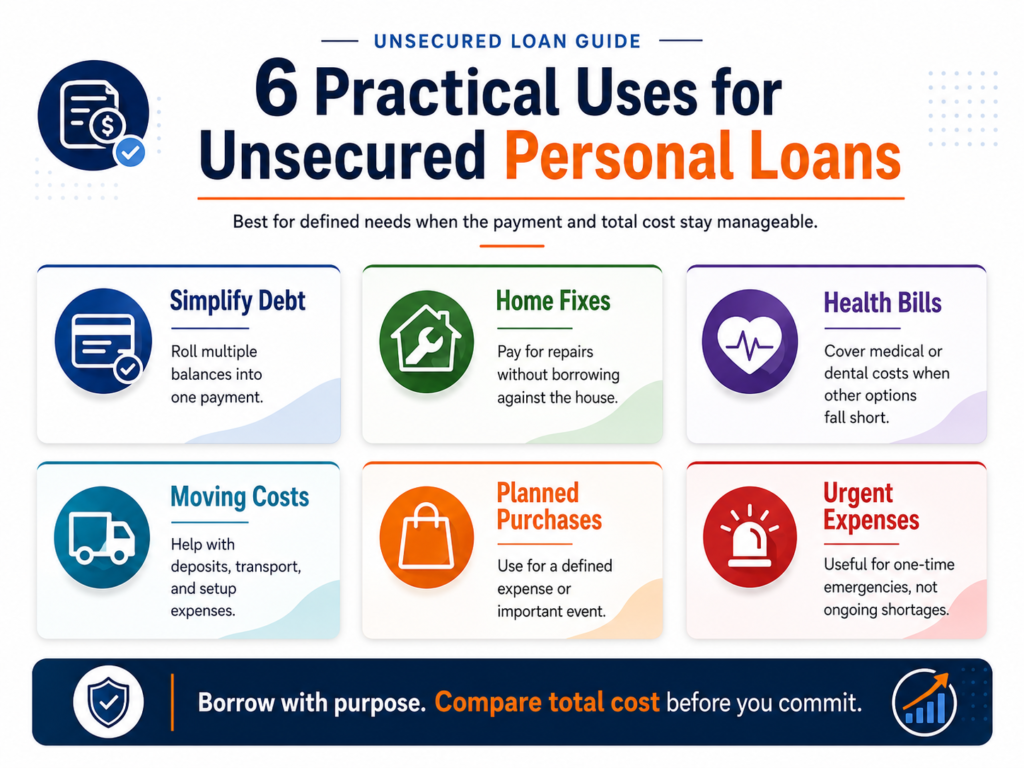
Common Uses for Unsecured Personal Loans
Unsecured personal loans can usually be used for a range of lawful personal expenses, subject to lender restrictions.
Debt Consolidation
A personal loan may combine multiple balances into one monthly payment.
Consolidation may help when:
- The new APR is lower
- Fees do not eliminate the savings
- The payment fits the budget
- The repayment term is reasonable
- Paid-off credit cards are not charged up again
Moving debt does not reduce it by itself. The result depends on the new cost and the borrower’s future use of credit.
Home Repairs
An unsecured loan may finance repairs without placing a lien on the home.
This may fit a defined project when the amount and payment are manageable. Larger projects may justify comparing the loan with home-equity products, while accounting for closing costs and collateral risk.
Medical and Dental Expenses
Before borrowing, ask the provider about:
- Payment plans
- Financial assistance
- Insurance adjustments
- Discounts
- Interest-free financing periods
A personal loan may still be appropriate when those options are unavailable or more expensive.
Moving and Relocation Costs
A lump-sum loan may cover deposits, transportation, temporary lodging, or essential setup costs.
The payment should remain manageable after accounting for the borrower’s new housing and living expenses.
Major Planned Expenses
A personal loan may finance a necessary purchase or defined event.
Flexible use of funds does not mean every use is financially sound. Long-term debt may be difficult to justify for short-lived discretionary spending.
Emergency Expenses
An unsecured personal loan may provide funds for a specific emergency when savings and lower-cost assistance are unavailable.
It is less suitable for recurring shortages. Borrowing for expenses that return each month may create a new payment without solving the underlying problem.

Unsecured Personal Loan: Costs, Fees, Terms, and Net Proceeds
The approved loan amount is not the only number that matters.
The true cost depends on the interest rate, APR, fees, repayment term, monthly payment, and total amount repaid.
Interest Rate and APR
The interest rate is the cost charged for borrowing the principal.
APR is broader. The CFPB explains that APR includes the interest rate plus additional loan fees.
This makes APR more useful when comparing offers with different fee structures.
A loan can advertise a lower interest rate but have a higher APR because it includes a substantial origination fee.
Origination Fees and Net Proceeds
An origination fee may be deducted before the loan is funded.
For example:
- Approved loan amount: $10,000
- Origination fee: $500
- Net proceeds: $9,500
The borrower receives $9,500 but repays the loan based on the $10,000 principal.
The CFPB notes that fees and charges can increase the total cost of a personal installment loan.
Compare the net proceeds with the amount actually needed. An offer may not solve the expense when deducted fees leave too little money.
Repayment Term and Monthly Payment
The repayment term determines how long the loan remains active.
A longer term generally lowers the monthly payment because repayment is spread across more installments. It can also increase the total interest paid.
A shorter term may save interest but create a payment that is difficult to manage.
The appropriate term balances monthly affordability with total cost.
Total Repayment and Other Charges
Review the full amount expected over the term.
Also check for:
- Late-payment fees
- Returned-payment fees
- Administrative charges
- Optional insurance
- Membership products
- Subscription services
- Early-payoff restrictions
Optional products can increase the amount owed or reduce the net proceeds.
Ask whether each product is required and what it costs over the full term.
Cost Example
Consider a $10,000 loan principal repaid over 36 months.
| Detail | 8% Interest Rate | 18% Interest Rate |
|---|---|---|
| Loan principal | $10,000 | $10,000 |
| Monthly payment | Approximately $313.36 | Approximately $361.52 |
| Total interest | Approximately $1,281.09 | Approximately $3,014.86 |
| 5% origination fee | $500 | $500 |
| Net proceeds | $9,500 | $9,500 |
The higher interest rate increases the monthly payment by about $48 and adds more than $1,700 in interest over the term.
Because the origination fee reduces the proceeds, the disclosed APR would be higher than the stated interest rate.
The example assumes equal monthly payments and no charges beyond the stated origination fee. The borrower receives $9,500 while repayment remains based on the $10,000 loan principal.
Unsecured Personal Loan: Benefits and Drawbacks
| Benefits | Drawbacks |
|---|---|
| No home, vehicle, or savings account must be pledged | APRs may be high when credit is weak |
| Defined repayment schedule | Qualification depends heavily on credit and income |
| Predictable payments when the rate is fixed | Fees may reduce net proceeds |
| Clear payoff date | Longer terms may increase total interest |
| Flexible use of funds | Missed payments can damage credit |
| No collateral appraisal or lien process | Collections and possible legal action may follow nonpayment |
The central benefit is avoiding direct collateral risk.
The central trade-off is that the lender prices and approves the loan primarily according to the borrower’s financial profile.

How to Compare Unsecured Personal Loan Offers
Use consistent criteria for every offer.
Compare the Same Loan Amount
Do not casually compare a $10,000 offer with a $15,000 offer.
The larger loan may look more useful, but it creates additional interest, a higher payment, and more debt.
Start with the amount actually needed.
Use Similar Repayment Terms
A three-year loan and a five-year loan are not directly equivalent.
The five-year offer may have a lower payment but a higher total repayment amount.
Compare similar terms first. Then consider whether extending the term improves affordability enough to justify the added cost.
Review APR, Not Only the Interest Rate
APR helps account for certain fees.
When two offers have similar interest rates, the one with the lower APR may carry fewer or smaller included charges.
Calculate Net Proceeds
Subtract deducted fees from the approved loan amount.
Confirm that the amount deposited will cover the intended expense.
Compare Monthly Payment and Total Repayment
Both matter.
The payment must fit normal cash flow. Extending the term to lower the payment may substantially increase the total amount paid.
Confirm Whether the Rate Is Fixed
A fixed rate supports predictable payments.
If the product has a variable rate, review how often it can change and how a rate increase would affect the payment.
Review Fees and Optional Products
Identify each cost before signing.
Do not assume that “no origination fee” means the agreement has no late, returned-payment, or optional-product charges.
Check Credit Reporting
Ask whether the lender reports:
- On-time payments
- Missed payments
- Account balances
- Account status
- Information to one or more major credit bureaus
Credit reporting can affect whether the loan contributes to payment history.
Review Funding Conditions
A fast estimate does not guarantee immediate funding.
Confirm what must happen before disbursement, including identity checks, document verification, bank-account confirmation, and final signing.
Read Early-Payoff and Default Terms
Confirm whether additional principal payments are allowed and whether any restrictions apply.
The agreement should also explain:
- When a payment becomes late
- When the account may enter default
- Which fees apply
- What collection action may follow
For current provider terms, compare our review of the best unsecured personal-loan lenders.
When an Unsecured Personal Loan May or May Not Fit
The right decision depends on the borrowing purpose, payment, total cost, and available alternatives.
When It May Fit
An unsecured personal loan may be worth considering when:
- The expense is specific and defined.
- A lump sum matches the need.
- The payment fits an ordinary monthly budget.
- The APR and total cost compare reasonably with alternatives.
- The net proceeds are sufficient.
- No essential asset must be pledged.
- The loan replaces more expensive debt without extending repayment excessively.
- The debt is likely to improve the borrower’s position rather than postpone a recurring shortage.
When It May Not Fit
Pause when:
- The payment works only under ideal conditions.
- Fees substantially reduce the proceeds.
- The APR makes total repayment excessive.
- The loan covers rent, groceries, utilities, or other recurring expenses.
- New debt is needed to make payments on existing debt.
- Repeated access to funds is needed instead of one lump sum.
- Income is too uncertain to support the payment.
- A payment plan, hardship program, or assistance option could address the need at a lower cost.
Approval answers whether the lender is willing to provide the money.
Suitability answers whether accepting the debt is likely to improve the borrower’s position.
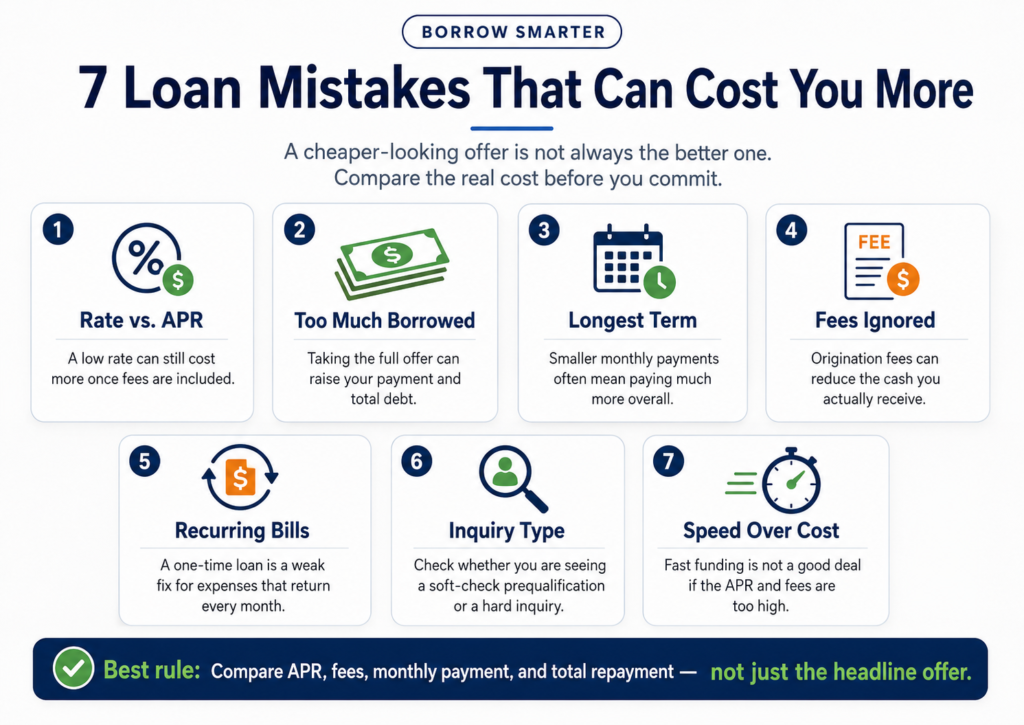
Common Mistakes to Avoid
Comparing the Interest Rate Instead of APR
A lower advertised rate may be offset by fees.
Use APR and net proceeds to compare offers more accurately.
Accepting the Largest Amount Offered
Borrowing more than necessary increases the payment, interest, and debt burden.
The maximum approval is not a spending recommendation.
Choosing the Longest Term for the Lowest Payment
A longer term may improve monthly affordability while substantially increasing total repayment.
Review both figures.
Ignoring Fees and Net Proceeds
An origination fee can leave the borrower with less money than expected.
Calculate the amount that will actually be deposited.
Borrowing for Recurring Expenses
A one-time loan is poorly matched to an expense that returns each month.
When regular expenses exceed regular income, borrowing may delay rather than resolve the problem.
Applying Before Confirming the Credit Inquiry
Some lenders offer soft-inquiry prequalification. A full application commonly involves a hard inquiry.
Confirm the inquiry type before proceeding.
Focusing on Funding Speed Instead of Cost
A faster offer may still be the more expensive offer.
When the expense allows time for comparison, evaluate APR, fees, payment, and total repayment before prioritizing speed.
How Unsecured Personal Loans Affect Credit
An unsecured personal loan can affect credit at several stages.
Application Inquiry
A formal application commonly results in a hard inquiry.
The effect depends on the scoring model and the borrower’s overall credit profile.
New Account and Balance
Opening a new installment account changes the credit file.
It may affect:
- Average account age
- Credit mix
- Total debt
- Recent credit activity
The result is not guaranteed to be positive or negative.
Payment History
On-time payments may support a positive payment record when the lender reports the account.
Late or missed payments may damage credit.
Confirm the lender’s reporting practices before accepting the loan.
Debt Consolidation
A consolidation loan may reduce revolving credit balances.
Its effect depends on what happens next. Charging the paid-off credit cards again can leave the borrower with both the personal loan and renewed card debt.
No loan guarantees a credit-score increase.
Borrowers with damaged credit can review our separate guide to unsecured personal loans for bad credit.
What Happens If You Miss Payments?
A missed payment may lead to several consequences.
The exact sequence depends on the agreement, lender policies, applicable law, and how long the account remains unpaid.
Possible consequences include:
- Late fees
- Negative credit reporting
- Loss of discounts
- Collection calls or notices
- Transfer or sale of the debt
- A lawsuit where permitted
An unsecured lender does not have an automatic claim against a specific pledged asset because no collateral was provided.
That does not prevent collection or legal action.
The Federal Trade Commission explains consumer rights involving debt collection, including restrictions on abusive, unfair, or deceptive collection practices.
Contact the lender as soon as repayment becomes uncertain.
Possible accommodations may include a due-date change, temporary arrangement, or hardship option. Assistance is not guaranteed, but early communication may provide more options than waiting until the account is seriously delinquent.
Unsecured Personal Loans vs. Other Forms of Credit
| Product | Funding Structure | Repayment Structure | Common Fit |
|---|---|---|---|
| Unsecured personal loan | One lump sum | Defined installment term | One-time expenses |
| Credit card | Revolving credit limit | Open-ended minimum payments | Smaller or ongoing purchases |
| Personal line of credit | Reusable draw limit | Payments vary with balance | Irregular or repeated needs |
| Secured personal loan | One lump sum | Defined installment term | Borrowers willing to pledge collateral |
An unsecured personal loan provides more repayment structure than revolving credit.
A credit card or line of credit may be more flexible when expenses arise repeatedly, but open-ended repayment and changing balances can make total costs less predictable.
A secured personal loan may offer different approval or pricing possibilities, but it exposes a pledged asset.
For a deeper comparison, see our guide to secured versus unsecured loans.

Alternatives to Consider
An unsecured personal loan is not the only way to address a financial need.
Secured Personal Loans
A secured loan may offer different approval or pricing terms by using an eligible asset as collateral.
The trade-off is the risk of losing or losing access to that asset.
Credit-Union Small-Dollar Loans
Some credit unions offer smaller installment loans to eligible members.
These may fit a limited expense that does not justify a larger personal loan.
Co-Signed Loans
A co-signer may support an application when the lender permits one.
The co-signer becomes responsible for repayment if the borrower does not pay.
Payment Plans
Medical providers, utilities, creditors, landlords, and other service providers may offer payment arrangements.
A plan may reduce the amount that needs to be borrowed.
Hardship Programs
Creditors and service providers may offer temporary assistance after income loss, illness, or another hardship.
Terms and eligibility vary.
Employer, Nonprofit, or Local Assistance
Some employers, community organizations, and government agencies help with essential expenses.
Non-loan assistance may be preferable when another monthly payment would be difficult.
See our full guide to alternatives to unsecured personal loans for a deeper comparison.
Conclusion
An unsecured personal loan provides a lump sum without requiring collateral.
That removes the direct risk of losing a pledged home, vehicle, or savings account. It does not remove borrowing risk.
Approval and pricing depend heavily on credit, income, existing debts, and repayment capacity. Fees may reduce the amount received, longer terms may increase total interest, and missed payments may lead to credit damage, collections, or legal consequences.
Compare offers using the same amount and similar terms. Review the APR, origination fee, net proceeds, monthly payment, total repayment, credit reporting, funding conditions, and default provisions.
The right offer should solve a defined need without creating a payment or total cost that the budget cannot reasonably support.
Frequently Asked Questions
Do Unsecured Personal Loans Require Collateral?
No. An unsecured personal loan does not require a specific pledged asset.
Approval depends primarily on the lender’s evaluation of credit, income, existing debts, and repayment capacity.
What Credit Score Is Needed?
There is no universal minimum.
Each lender sets its own standards, and some use broader underwriting models. A stronger credit profile may support more options or lower costs, but it does not guarantee approval.
Are Unsecured Personal Loans Hard to Qualify For?
Qualification depends on the lender and borrower.
Credit history, income, existing obligations, requested amount, and repayment capacity may all affect the decision.
What Is the Difference Between APR and Interest Rate?
The interest rate is the cost charged for borrowing the principal.
APR includes the interest rate and certain additional loan fees, making it more useful for comparing offers.
How Much Can You Borrow?
Available amounts vary by lender and applicant.
Income, credit history, existing debts, requested term, and lender limits may influence the amount offered.
How Long Does Funding Take?
Funding time varies.
Document verification, application timing, lender procedures, and bank-transfer conditions can all affect when the money arrives.
Can an Unsecured Personal Loan Help Build Credit?
It may help establish payment history when the lender reports the account and payments are made on time.
The overall effect depends on the complete credit profile. No score increase is guaranteed.
Can You Pay the Loan Off Early?
Many lenders permit early payoff, but agreement terms vary.
Review whether additional principal payments are allowed and whether any charge or restriction applies.
What Happens If You Stop Paying?
The lender may charge fees, report missed payments, send or sell the account to collections, or pursue legal action where permitted.
Contact the lender early when repayment becomes difficult.
Is an Unsecured Personal Loan Better Than a Credit Card?
It depends on the need.
A personal loan may be better for a fixed expense when predictable payments and a defined payoff date matter. A credit card may offer more flexibility for smaller or repeated purchases but can become expensive when balances remain unpaid.

0 Comments