An unsecured personal loan can provide a predictable lump sum without requiring collateral. It is not always the right structure for the expense.
The available APR may be too high. An origination fee may leave too little money after funding. The borrower may need repeated access rather than one lump sum, or another monthly payment may place too much pressure on an already strained budget.
In those situations, the better option may be a different credit product, an arrangement with the provider or creditor, or a solution that avoids new debt entirely.
The right choice depends on why the money is needed, how much is required, whether the expense is one-time or recurring, and how quickly repayment is possible. It also depends on whether the borrower can accept collateral risk or place repayment responsibility on another person.
This guide compares the main alternatives to unsecured personal loans and explains how to determine whether one creates a more manageable path.
Key Takeaways
- A non-loan solution may be stronger when another monthly debt payment would strain the budget.
- The financing structure should match the expense. Lump sums, revolving credit, payment plans, and hardship arrangements solve different problems.
- Compare total cost rather than choosing the option with the smallest monthly payment.
- Payment plans and hardship programs may address a specific expense without requiring a separate loan.
- Secured borrowing may create different approval or pricing possibilities, but it exposes the pledged asset.
- Joint or co-signed borrowing creates legal responsibility and credit risk for another person.
- Promotional rates, variable rates, and short repayment schedules require a clear payoff plan.
- A high-cost product is not a useful alternative when it replaces one unaffordable obligation with another.
Disclosure: This site may contain affiliate links. We may receive compensation if you use certain links, at no additional cost to you. Compensation does not determine our editorial conclusions.
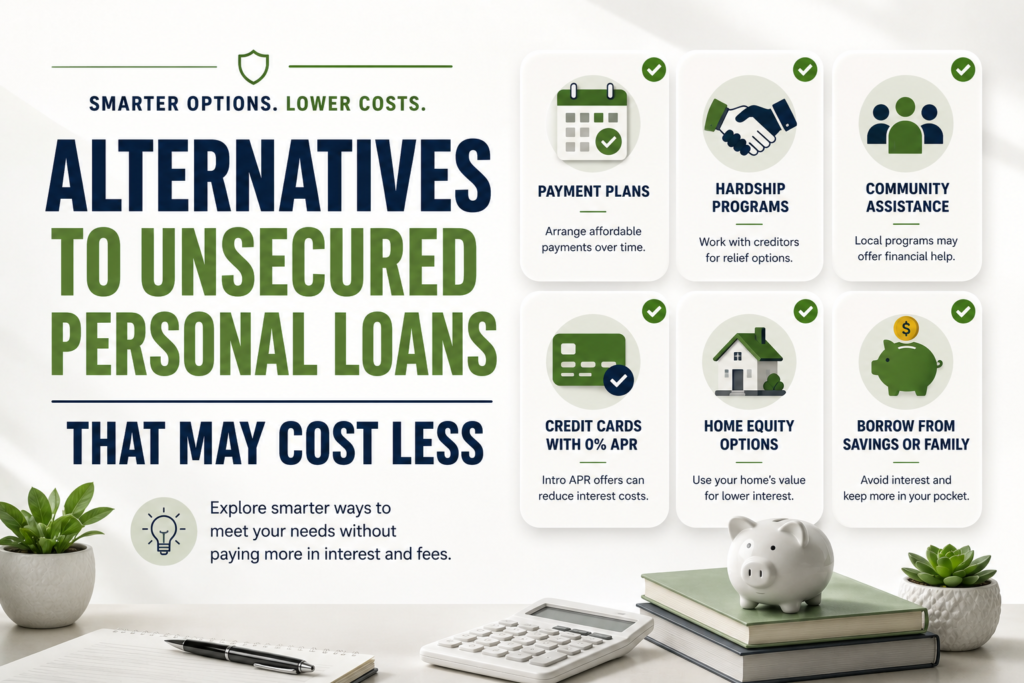
When an Unsecured Personal Loan May Not Fit
An unsecured personal loan may be unsuitable even when a lender is willing to approve the application.
Another option may deserve consideration when:
- Every available offer has an unaffordable APR or monthly payment.
- An origination fee leaves insufficient net proceeds.
- The expense returns every month.
- The amount needed is too small to justify a conventional installment loan.
- The borrower needs repeated access to funds rather than one disbursement.
- Current credit, income, or debt levels prevent affordable qualification.
- The payment would leave little room for ordinary expenses or emergencies.
- New borrowing would deepen an existing debt problem.
The absence of a suitable personal-loan offer does not mean the next available credit product is automatically better.
Each alternative should be evaluated according to its cost, payment structure, eligibility rules, and consequences.
How to Compare the Alternatives
Different products cannot be compared using the interest rate alone.
A provider payment plan, credit card, line of credit, home-equity product, and secured personal loan may calculate costs and payments differently. A useful comparison applies the same decision framework to each option.
Total Cost
Identify every amount the option may require.
Depending on the product, total cost may include:
- Interest
- Origination fees
- Balance-transfer fees
- Annual fees
- Closing costs
- Appraisal or title charges
- Membership costs
- Late fees
- Transaction fees
- Optional add-on products
A zero-interest promotion may still include an upfront fee. A home-equity product may include closing costs even when its rate is lower than an unsecured alternative.
Compare the full cost under the terms you realistically expect to use.
Repayment Structure
Determine how the balance must be repaid.
A personal installment loan normally has a defined payment schedule and payoff date. Other options may use:
- Revolving minimum payments
- Variable monthly payments
- Short promotional periods
- Deferred-payment arrangements
- Temporary reduced payments
- Reusable credit limits
- Separate draw and repayment periods
The structure should match the borrower’s income and the nature of the expense.
Monthly Affordability
Test the payment against an ordinary month.
Do not base affordability on unusually high income, temporary overtime, a future bonus, or the assumption that no unexpected costs will arise.
The payment should leave enough room for housing, food, utilities, transportation, insurance, medical expenses, existing debt, and routine financial disruptions.
A low payment is not helpful when it extends the debt excessively or allows the balance to keep growing.
Access to Funds
Consider how and when the money becomes available.
Some options provide cash directly. Others pay a creditor, provider, merchant, contractor, or medical office.
Review the approval requirements, processing time, funding method, restrictions on use, and whether the initial offer remains conditional on verification.
Speed should remain secondary to affordability unless the expense is genuinely urgent.
Collateral and Shared-Responsibility Risk
Identify who or what is exposed if repayment fails.
A secured loan may place a savings account, certificate, vehicle, or home at risk.
A joint or co-signed loan may affect another person’s credit and finances. That person may be required to repay the debt when the primary borrower does not.
These risks should be treated as part of the decision even when they do not appear in the APR.
Suitability for the Expense
Match the option to the actual need.
A one-time, fixed expense may fit an installment product or provider payment plan.
Repeated or uncertain costs may fit a line of credit more closely, although revolving access can make total borrowing less predictable.
A temporary hardship may call for an arrangement with the existing creditor rather than a new loan.
An expense that can be postponed or reduced may not require financing at all.
Alternatives That May Avoid a New Loan
Avoiding new debt can be the strongest outcome when repayment capacity is limited.
These options address the expense directly rather than adding a separate lender and another monthly obligation.
Provider Payment Plans
Medical offices, dental providers, hospitals, schools, contractors, utilities, landlords, and other service providers may allow a bill to be paid over time.
A provider plan may fit when the expense is specific, the terms are clear, and the scheduled payment is manageable.
Before agreeing, ask:
- Does the balance accrue interest?
- Is there an administrative fee?
- Is a down payment required?
- What happens after a missed payment?
- Can the account be sent to collections?
- Does a third-party finance company manage the plan?
- Will the arrangement appear on a credit report?
A provider plan is not automatically interest-free or less expensive. Read the written agreement rather than relying on a verbal description.
Creditor Hardship Programs
An existing creditor may offer temporary assistance after job loss, reduced income, illness, disaster, or another financial hardship.
Possible accommodations may include:
- A changed due date
- A temporary payment reduction
- A fee waiver
- A payment pause
- A lower rate
- A structured repayment arrangement
Assistance is not guaranteed. The creditor may require documentation, and reduced or deferred amounts may still need to be repaid later.
Ask how the arrangement affects interest, account status, repayment length, and credit reporting. The Consumer Financial Protection Bureau recommends contacting a credit-card issuer immediately when a payment cannot be made and explaining what the borrower can afford.
Employer, Nonprofit, or Community Assistance
Some expenses may qualify for help that does not create conventional consumer debt.
Possible sources include:
- Employer hardship funds
- Employee assistance programs
- Local utility assistance
- Medical financial-assistance programs
- Community action agencies
- Nonprofit grants
- Religious or charitable organizations
- Government benefit programs
Availability depends on location, employer, income, expense type, and program funding.
Assistance that does not require repayment can be preferable when the borrower cannot safely manage another payment.
Employer payroll advances require separate caution. A deduction from the next paycheck can create another shortage when the following month’s budget is already tight.
Delaying or Reducing the Expense
Postponing or reducing the expense is a legitimate alternative when the need is not immediate.
Possible approaches include:
- Requesting a smaller project scope
- Obtaining additional estimates
- Negotiating the price
- Buying a lower-cost replacement
- Completing the expense in stages
- Saving part of the amount first
- Postponing nonessential spending
Reducing the amount can change the available options.
A smaller expense may fit existing savings, a provider arrangement, or a shorter repayment period without requiring a large personal loan.
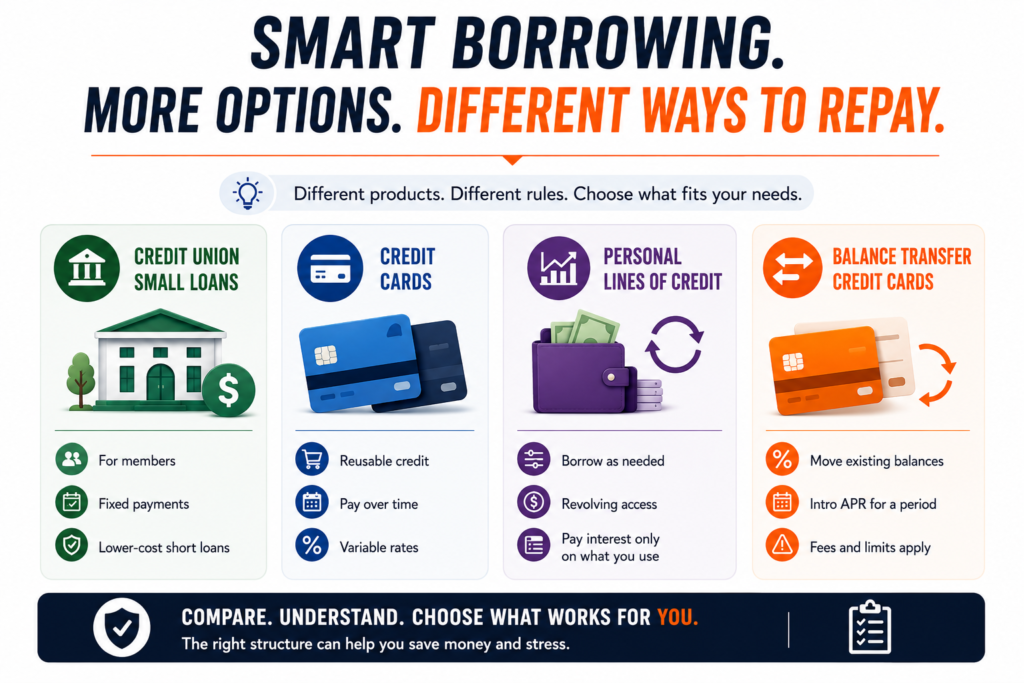
Borrowing Options With Different Repayment Structures
These products still create debt, but they operate differently from a conventional unsecured personal installment loan.
The different structure may help when it matches the expense. It can also create variable costs or less predictable repayment.
Credit-Union Small-Dollar Loans
Credit unions may offer conventional small personal loans to eligible members.
Federal credit unions may also offer Payday Alternative Loans, commonly called PALs. These products are subject to National Credit Union Administration rules covering loan amounts, repayment terms, application fees, and rate limits.
A credit-union small-dollar loan may fit:
- A relatively small one-time expense
- A borrower who qualifies for membership
- Someone seeking structured installment payments
- An applicant comparing alternatives to high-cost short-term credit
Compare:
- Membership requirements
- APR
- Application fee
- Loan amount
- Repayment term
- Waiting period
- Credit inquiry
- Payment reporting
PAL availability is not universal. A credit union may offer another small-dollar product with different terms.
The National Credit Union Administration explains the rules governing federal credit-union PALs, including limits on rates, amounts, fees, and repayment terms.
Credit Cards
A credit card may fit a smaller purchase or an expense the borrower can repay over a short period.
Potential advantages include reusable access, a possible grace period on purchases, and promotional pricing for qualified applicants.
The main risks are:
- Variable APRs
- Open-ended repayment
- Minimum payments that reduce the balance slowly
- Continued spending after the original purchase
- Promotional pricing that later expires
A card is less suitable when the borrower expects to carry a substantial balance without a defined payoff plan.
The ability to reuse the limit can be helpful, but it can also turn one expense into continuing debt. The CFPB’s credit-card consumer guidance explains common rates, fees, payment terms, and account disclosures.
Personal Lines of Credit
A personal line of credit provides access to funds as needed, up to an approved limit.
Unlike a lump-sum personal loan, the borrower can draw, repay, and potentially borrow again according to the agreement.
A line of credit may fit:
- An expense with an uncertain final cost
- A project completed in stages
- Repeated short-term needs
- Irregular cash-flow gaps that can be repaid promptly
Compare:
- Variable or fixed rate
- Draw period
- Minimum payment
- Annual fee
- Transaction fee
- Credit limit
- Repayment conditions
- Inactivity or maintenance charges
- Credit reporting
Flexibility makes the product useful, but it can also make the total cost less predictable. Repeated draws may prevent the balance from declining.
The CFPB defines a personal line of credit as an account that can be accessed repeatedly, with interest generally based on the outstanding balance.
Balance-Transfer Credit Cards
A balance-transfer card is designed primarily to move existing revolving debt to a new credit card, often with a temporary promotional APR.
This is different from using a standard credit card to finance a new purchase.
A balance transfer may fit a borrower who can repay most or all of the transferred amount during the promotional period.
Review:
- Transfer fee
- Promotional APR
- Length of the promotion
- Credit limit
- Amount eligible for transfer
- Transfer deadline
- Standard APR after the promotion
- Treatment of new purchases
- Consequences of late payments
The approved credit limit may not be high enough to transfer the full balance.
A zero-percent offer can still carry a balance-transfer fee. The CFPB explains that balance-transfer fees may apply to zero-percent offers.
New purchases may also be treated differently from the transferred balance. Review the agreement before using the account for additional spending.
Options That Involve Collateral or Shared Responsibility
These options may create different approval or pricing possibilities by giving the lender additional protection.
That protection creates risk for the borrower, another person, or both.
Secured Personal Loans
A secured personal loan uses an eligible asset to support repayment.
Possible collateral may include:
- A savings account
- A certificate of deposit
- A vehicle
- Other property accepted by the lender
Collateral may affect the lender’s decision or available terms. It does not make the payment affordable automatically.
Review:
- Which asset secures the loan
- How the asset is valued
- Whether access is restricted
- What happens after default
- How the lender may claim or liquidate the asset
- When the collateral is released after payoff
Do not pledge an essential asset without considering the consequences of losing it or being unable to use it.
Home-Equity Loans or HELOCs
Home-equity loans and home equity lines of credit allow eligible homeowners to borrow against the equity in their property.
A home-equity loan generally provides a lump sum secured by the home.
A home equity line of credit generally provides revolving access during a defined draw period.
These products may offer different rates or larger limits than unsecured borrowing, but they place the home at risk.
Compare:
- Fixed or variable rate
- Closing costs
- Appraisal and title fees
- Draw and repayment periods
- Minimum draw requirements
- Annual fees
- Changes in required payments
- Total interest
- Foreclosure risk
A home-equity product is not automatically a stronger alternative because its rate is lower.
Using home equity for an expense converts the obligation into debt secured by the property. Failure to repay can place the home at risk.
Co-Signed or Joint Loans
A co-signed or joint loan includes another person in the borrowing arrangement.
A co-signer generally agrees to repay if the primary borrower does not. A joint borrower usually applies for and shares responsibility for the loan.
Terminology varies by lender.
Another applicant’s income or credit may affect approval or available terms. The arrangement also places that person’s credit and finances at risk.
Before proceeding, both parties should understand:
- Who receives the funds
- Who must make payments
- How the account will be reported
- Whether both incomes are considered
- What happens after a missed payment
- Whether a release option exists
- How the debt may affect future borrowing
The CFPB explains that a co-signer becomes legally responsible for repayment when the primary borrower does not pay.
A personal relationship does not reduce the legal responsibility created by the agreement.
Alternatives That Require Extra Caution
Some products may appear easier to access than an unsecured personal loan. Their cost, repayment pressure, collateral exposure, or sales practices can make them poor substitutes.
Payday Loans
Payday loans generally require repayment over a short period and can carry a high effective cost.
The short schedule may require the borrower to use a large portion of the next paycheck for repayment, leaving insufficient money for ordinary expenses and increasing the risk of repeated borrowing.
Vehicle-Title Loans
A vehicle-title loan uses the vehicle title as security.
The borrower may lose the vehicle after default. That consequence can affect transportation, employment, childcare, and the ability to recover financially.
Advance-Fee Loan Offers
A company that promises financing in exchange for an upfront payment may be operating a scam.
Do not pay a fee to guarantee approval or release loan proceeds.
A legitimate lender may disclose an origination fee as part of an approved loan. That is different from demanding money before providing the promised financing.
The Federal Trade Commission warns that advance-fee loan scams often target people who have difficulty qualifying elsewhere.
High-Cost Cash Advances
Cash advances may include transaction fees, subscription charges, expedited-transfer costs, tips, or other expenses.
The total cost can be difficult to compare with a conventional installment loan, particularly when repayment occurs over a very short period.
A deduction from the next deposit may also create another cash-flow shortage.
Buy Now, Pay Later Plans
Buy now, pay later plans divide a purchase into several scheduled payments.
The product may appear manageable when each installment is small. Problems can develop when several plans overlap or automatic payments arrive before sufficient funds are available.
Review:
- Number and timing of payments
- Late or returned-payment fees
- Autopay requirements
- Credit reporting
- Refund and dispute procedures
- Interest on longer-term plans
- Consequences of missed payments
BNPL should remain tied to a specific purchase and repayment plan. It is not a solution for recurring budget shortages.
The CFPB’s research on the buy now, pay later market found that some borrowers use several BNPL loans at the same time, which can create overlapping payment obligations.
Which Alternative May Fit the Situation?
| Situation | Option to Compare | Main Advantage | Main Risk |
|---|---|---|---|
| Specific provider bill | Provider payment plan | May avoid a separate loan | Fees or collection terms may apply |
| Temporary financial hardship | Creditor hardship program | May reduce immediate pressure | Assistance is not guaranteed |
| Small one-time need | Credit-union small-dollar loan | Structured repayment | Membership and eligibility requirements |
| Smaller purchase with rapid payoff | Credit card | Reusable access and possible grace period | Variable cost and open-ended repayment |
| Repeated or uncertain expenses | Personal line of credit | Funds can be drawn as needed | Cost and repayment are less predictable |
| Existing revolving debt | Balance-transfer card | Promotional pricing may reduce interest temporarily | Transfer fee and post-promotional APR |
| Available savings or other collateral | Secured personal loan | Different approval or pricing possibilities | Asset loss or restricted access |
| Larger homeowner expense | Home-equity loan or HELOC | Potential access to larger amounts | Home-secured repayment risk |
| Shared application | Joint or co-signed loan | Another financial profile is considered | Shared legal and credit responsibility |
| Essential need with weak repayment capacity | Assistance program | May avoid new debt | Limited availability |
| Nonessential or adjustable expense | Delay or reduce the expense | Avoids or reduces borrowing | The need may remain unresolved |
The table identifies options to investigate. It does not establish that an option is affordable or appropriate for every borrower.

How to Decide Before Applying
Comparing alternatives can identify the strongest option on paper. The final question is whether that option still works within the borrower’s actual budget, risk tolerance, and repayment capacity.
- Before applying or signing an agreement, confirm that the option:
- Covers the full expense after fees, deposits, transfer limits, or closing costs.
- Matches the need, whether it requires a lump sum, revolving access, or temporary relief.
- Produces a payment that fits an ordinary monthly budget.
- Has a total cost proportionate to the amount received and the value of the expense.
- Does not expose an essential asset or another person without a clear reason and full understanding of the risk.
- Has missed-payment consequences the borrower can identify and evaluate.
- Solves the underlying problem rather than moving it to a later month.
An option should move forward only when each of these conditions is reasonably satisfied. If the payment depends on uncertain income, the fees leave too little money, or the risk falls on an essential asset or another person, the stronger decision may be to reduce the expense, seek assistance, or postpone borrowing.
Common Mistakes to Avoid
Choosing the Easiest Approval
Easier qualification does not establish that the product is affordable or appropriate.
Compare the cost and consequences after approval.
Comparing Payments Instead of Total Cost
A smaller payment may result from a longer term, revolving minimum, or deferred balance.
Review how much will be repaid and how long the obligation may remain.
Using Revolving Credit Without a Payoff Plan
Credit cards and lines of credit can remain open indefinitely.
Set a borrowing limit and a specific repayment target before using them.
Accepting Collateral or Shared Risk Without Full Discussion
Pledging an asset or involving another person changes the consequences of default.
Understand those consequences before signing.
Replacing One Unaffordable Product With Another
An alternative is not stronger when it creates the same payment problem through a different structure.
The correct decision may be to reduce the expense, seek assistance, negotiate terms, or postpone borrowing.
Conclusion
An alternative to an unsecured personal loan is useful only when it better matches the expense and creates a manageable repayment path.
Provider payment plans, hardship programs, assistance, and expense reduction may solve the problem without a new loan. Credit-union loans, credit cards, lines of credit, and balance-transfer cards provide different repayment structures. Secured and shared loans may expand available options while introducing collateral or legal risk.
Compare the complete cost, not only the payment. Identify whether the rate can change, whether fees reduce the amount received, and whether the product exposes a home, vehicle, savings account, or another person.
The strongest option solves a defined need without creating a repayment burden the borrower cannot reasonably sustain.
Frequently Asked Questions
What Is the Best Alternative to an Unsecured Personal Loan?
There is no single best alternative.
The strongest option depends on the expense, amount needed, repayment period, credit profile, and whether the borrower can accept collateral or shared responsibility.
A payment plan or assistance program may be better when another loan payment would strain the budget.
Is a Payment Plan Better Than a Personal Loan?
It may be better when the plan addresses a specific bill, provides manageable written terms, and costs less than borrowing.
Review interest, fees, missed-payment consequences, collection terms, and whether a third-party lender manages the plan.
Are Credit-Union Loans Easier to Qualify For?
Some credit unions may use different underwriting standards or offer small-dollar products to eligible members.
Approval is not guaranteed. Membership, income, credit history, existing debts, loan amount, and product rules may still apply.
Is a Secured Personal Loan Less Expensive?
Collateral may support different rates or approval terms, but a secured loan is not always less expensive.
Compare APR, fees, term, and total repayment. Also account for the risk of losing or losing access to the pledged asset.
Should I Use a Credit Card Instead of a Personal Loan?
A credit card may fit a smaller expense that can be repaid promptly.
A personal loan may provide a clearer payoff schedule for a larger one-time need. Compare the APR, repayment structure, fees, and expected payoff period.
What Is the Difference Between a Line of Credit and a Personal Loan?
A personal loan generally provides one lump sum with a defined installment schedule.
A line of credit allows repeated borrowing up to a limit. Payments and total cost may change as the balance changes.
Can a Co-Signer Help Me Obtain Better Terms?
A qualified co-signer may affect approval or available terms when the lender permits co-signers.
The co-signer becomes legally responsible for repayment and may face credit damage or collection activity if the borrower does not pay.
What Should I Consider Before Borrowing Against My Home or Savings?
Review the total cost, repayment term, fees, and consequences of default.
Home-equity borrowing can place the home at risk. Savings-secured borrowing may restrict access to money that would otherwise serve as an emergency fund.
What Options Are Available When I Cannot Afford Another Payment?
Consider provider payment plans, hardship programs, employer assistance, nonprofit or community support, expense reduction, and postponement when possible.
Non-loan assistance may be more appropriate when repayment capacity is limited.
Which High-Cost Alternatives Require Extra Caution?
Payday loans, vehicle-title loans, advance-fee offers, expensive cash advances, and overlapping BNPL plans require careful review.
Their risks may include high costs, short repayment periods, asset loss, repeated borrowing, overlapping payments, and fraud.

0 Comments