Introduction
One missed due date can turn a tight month into late fees, added interest, and more financial pressure.
When credit cards, medical bills, personal loans, and other balances all have separate payment schedules, the problem is not just the amount you owe. It is also the difficulty of keeping everything organized while interest keeps adding up.
A debt consolidation loan can combine multiple debts into one fixed monthly payment.
This guide explains how debt consolidation loans work, how to compare lenders, when they make sense, and which alternatives may be safer or cheaper depending on your situation.
Key Takeaways
- Simplicity: Debt consolidation makes payments easier to manage by replacing multiple due dates with one predictable repayment plan.
- Total Cost vs. Monthly Payment: A lower monthly payment is not always better if it drastically extends your timeline and increases the total interest you pay.
- Top Lenders: The best personal loan lenders for consolidation offer fixed rates, low origination fees, and the ability to pay your creditors directly.
- Alternatives Exist: If a personal loan does not fit your needs, balance transfer cards or nonprofit debt management plans can offer excellent alternatives.
- The Golden Rule: Debt consolidation only works if it simplifies repayment and prevents you from building up new balances on the credit cards you just paid off.
Disclaimer: This site contains affiliate links. If you make a purchase, we may earn a commission at no extra cost to you.
What Is a Debt Consolidation Loan?
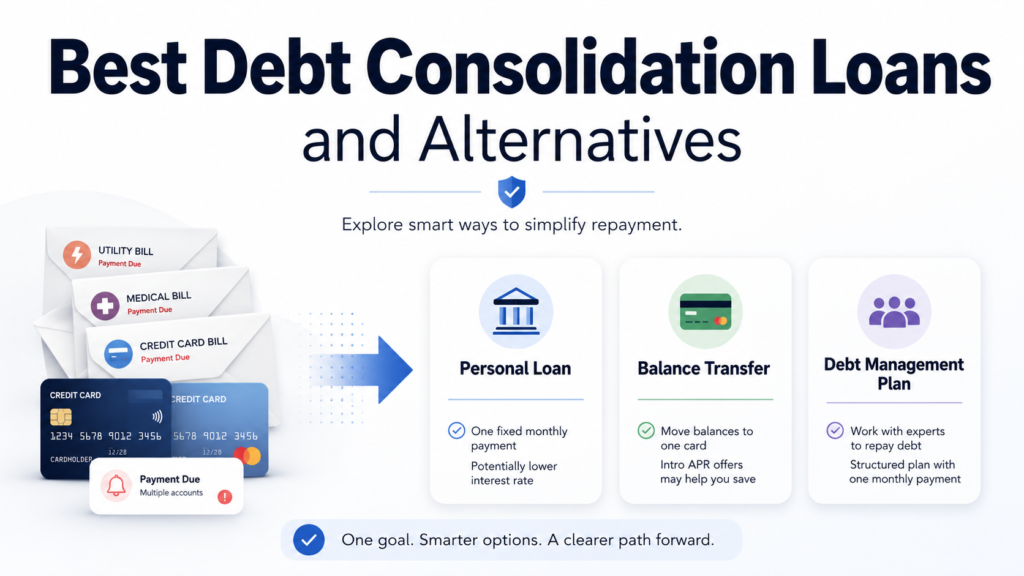
A debt consolidation loan is a personal loan used to pay off multiple existing debts, such as credit cards, medical bills, or other unsecured balances.
Instead of making several payments to different lenders each month, you use the new loan to bring those balances down to zero. Then you repay the consolidation loan through one fixed monthly payment over a set term.
The main goal is to make repayment simpler and, ideally, less expensive. A debt consolidation loan is most useful when it gives you a lower APR than your current debts, a clear payoff date, and a monthly payment you can realistically afford. It is less helpful if the loan comes with high fees, a much longer repayment term, or an interest rate that does not actually reduce your total cost.
Top Debt Consolidation Loan Lenders for 2026
The best debt consolidation loan is not always the loan with the lowest advertised rate. The better choice is the loan that gives you a competitive APR, clear fees, a realistic monthly payment, and enough structure to help you actually pay the debt down.
Rates and terms below are current as of May 2026, but they can change. Always prequalify and compare the final APR, fees, repayment term, monthly payment, and total interest before choosing a lender.
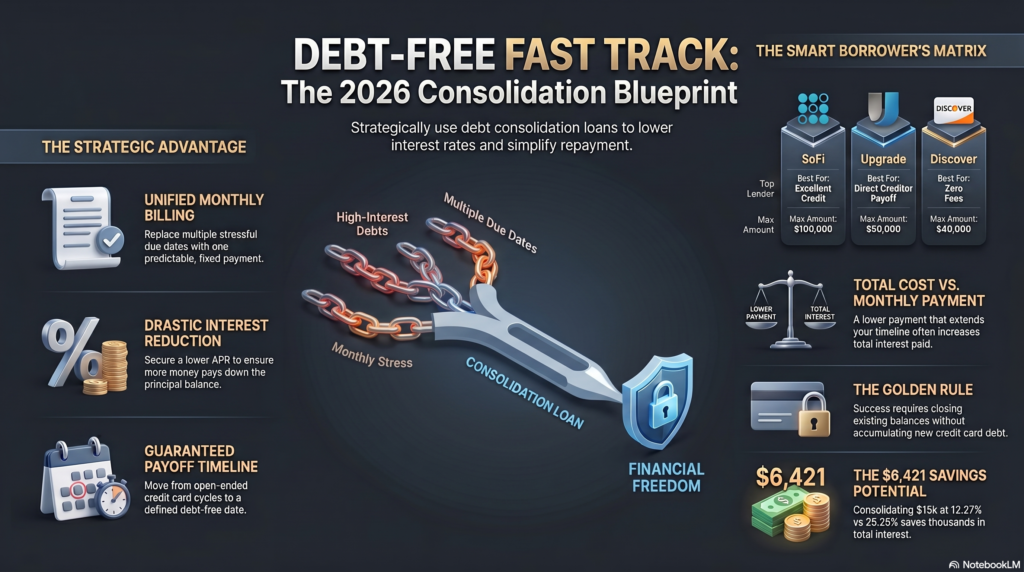
| Lender | Best For | Loan Amounts | APR Range | Key Detail |
|---|---|---|---|---|
| SoFi | Excellent credit and larger balances | $5,000 to $100,000 | 7.74% to 35.49% | Large loan limits and no required origination fee option |
| Upgrade | Direct creditor payoff | Up to $50,000 | 7.74% to 35.99% | Can pay creditors directly; origination fee applies |
| Upstart | Borrowers with limited or fair credit history | $1,000 to $75,000 | 6.20% to 35.99% | Uses more than credit score alone in underwriting |
| Discover | No-fee personal loans | $2,500 to $40,000 | 7.99% to 24.99% | No fees and funds may be sent as soon as the next business day |
SoFi: Best for Excellent Credit and Larger Balances
SoFi may be a strong option if you have good to excellent credit and need to consolidate a larger amount of debt. Its personal loans range from $5,000 to $100,000, which makes it useful for borrowers with higher credit card balances or multiple debts to combine. SoFi lists fixed APRs from 7.74% to 35.49% for credit card consolidation loans, with available rate discounts for autopay and qualifying member activity.
SoFi is best for borrowers who want a larger loan, prefer a fixed repayment schedule, and can qualify for one of the lender’s better rates. It may not be the best fit if you need a small loan under $5,000 or if your credit profile makes the higher end of the APR range more likely.
Upgrade: Best for Direct Creditor Payoff
Upgrade is worth considering if you want the lender to send funds directly to your creditors. That feature can make consolidation cleaner because the loan proceeds go toward paying down the debts you selected instead of sitting in your bank account.
Upgrade personal loans have APRs from 7.74% to 35.99%, repayment terms from 24 to 84 months, and origination fees from 1.85% to 9.99% deducted from the loan proceeds. Upgrade says its lowest rates require autopay and paying off a portion of existing debt directly.
Upgrade may be a good fit if you value direct payoff and are comfortable comparing the origination fee against the interest savings. Before accepting an offer, make sure the loan amount you receive after fees is enough to pay off the debts you want to consolidate.
Upstart: Best for Borrowers With Limited or Fair Credit History
Upstart may be helpful for borrowers who have steady income but do not look ideal under traditional credit scoring alone. Its lending model considers credit, income, and other application information, and the company says applicants can check their rate without affecting their credit score.
Upstart personal loans range from $1,000 to $75,000, with fixed APRs from 6.20% to 35.99% and available three- or five-year terms.
Upstart may be worth comparing if you have fair credit, a shorter credit history, or a stronger employment and income profile than your credit score suggests. It is still important to review the final APR carefully, because borrowers who qualify near the top of the rate range may not save money by consolidating.
Discover: Best for No Fees
Discover is a strong option for borrowers who want a straightforward personal loan without origination fees, late fees, or prepayment penalties. Its personal loans range from $2,500 to $40,000, with APRs from 7.99% to 24.99% and terms from 36 to 84 months. Discover also says funds can be sent as early as the next business day after acceptance.
Discover may be a good fit if you qualify for a competitive rate and want to avoid upfront loan fees. The lower maximum loan amount means it may not work for borrowers who need to consolidate more than $40,000.

How We Chose the Best Debt Consolidation Loans
We evaluated debt consolidation lenders based on the factors that matter most when the goal is to pay debt down safely, not simply move it somewhere else.
Our review focused on APR ranges, loan amounts, repayment terms, fees, funding speed, credit accessibility, and whether the lender offers direct payment to creditors. We gave stronger consideration to lenders with fixed rates, transparent costs, no or low origination fees, and clear prequalification options that let borrowers compare rates without immediately affecting their credit score.
We also looked at how each lender fits different borrower needs. Some lenders are better for excellent-credit borrowers with larger balances, while others may be more accessible for people with fair credit, smaller loan needs, or a preference for direct creditor payoff.
The lenders in this guide were selected because they offer a combination of competitive terms, clear borrower protections, and practical debt consolidation features. Still, the best choice depends on your credit profile, income, loan amount, current debts, and the final offer you receive. Always compare the total cost of the loan, not just the advertised rate or monthly payment.
Pros and Cons of Debt Consolidation Loans
A debt consolidation loan can make repayment easier, but it is not a perfect solution for every borrower. The main question is whether the new loan improves your overall repayment plan or simply makes the monthly payment look more manageable.
| Pros | Cons |
|---|---|
| One monthly payment: Combining several debts into one loan can make your budget easier to manage. | Possible origination fees: Some lenders deduct an upfront fee from your loan amount. |
| Fixed payoff timeline: Personal loans usually have a set repayment term, so you know when the debt will be paid off. | Longer terms can cost more: A lower monthly payment may increase total interest if you repay the loan over more years. |
| Potential interest savings: If you qualify for a lower APR than your current debts, more of your payment can go toward principal. | Approval depends on credit and income: Borrowers with lower credit scores may receive rates that do not save money. |
| May improve credit utilization: Paying down revolving credit card balances can help your credit profile over time. | Risk of new credit card debt: If you keep using the cards you paid off, you could end up with both the loan and new balances. |
| Predictable payments: Fixed rates and fixed payments can make planning easier. | Not a cure for overspending: Consolidation helps with structure, but it does not solve the habits or expenses that created the debt. |
A debt consolidation loan is most helpful when it lowers your APR, keeps repayment affordable, and gives you a clear path to paying the debt off. It is less helpful when the savings are small, the fees are high, or the loan simply delays the problem instead of reducing the total cost.
The Math: How a Debt Consolidation Loan Can Save Money
Debt consolidation is worth considering when the new loan lowers your total repayment cost, not just your monthly payment. The key comparison is simple: look at what you owe now, your current APR, the new loan APR, any fees, and how long repayment will take.
For example, say you have $15,000 in credit card debt and want to pay it off over five years. Forbes Advisor reported an average credit card interest rate of 25.28% in May 2026, while Bankrate reported an average personal loan rate of 12.27% for borrowers with a 700 FICO score, a $5,000 loan, and a three-year term. Your actual rate will depend on your credit, income, loan amount, lender, and repayment term.
| Scenario | Balance | APR | Repayment Term | Monthly Payment | Total Interest |
|---|---|---|---|---|---|
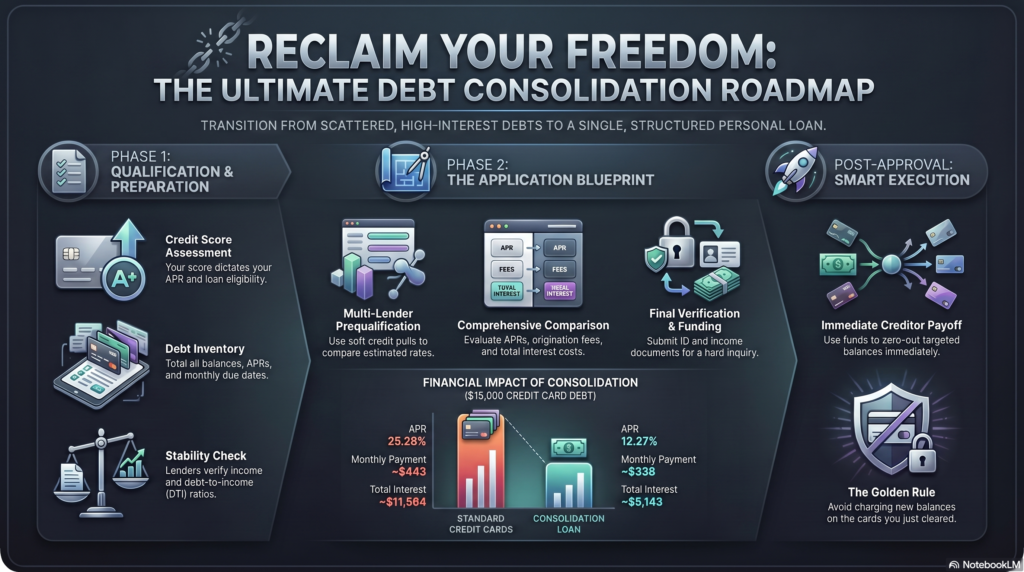
| Keep the debt on credit cards | $15,000 | 25.28% | 60 months | About $443 | About $11,564 |
| Consolidate with a personal loan | $15,000 | 12.27% | 60 months | About $336 | About $5,143 |
In this example, the consolidation loan would lower the monthly payment by about $107 and reduce total interest by about $6,421, assuming there are no added fees and the borrower does not take on new debt.
The same math can work against you if the loan has a high APR, a large origination fee, or a much longer repayment term. Before accepting an offer, compare the total interest and fees over the full life of the loan. A lower monthly payment is only helpful if it supports your budget without making the debt more expensive overall.
How to Qualify and Apply for a Debt Consolidation Loan
Qualifying for a debt consolidation loan depends mainly on your credit score, income, debt-to-income ratio, and repayment history. Before you apply, make sure the new loan is likely to improve your situation by lowering your APR, simplifying repayment, or giving you a clearer payoff timeline.
- Check your credit score: Your credit score helps determine whether you qualify and what APR you may receive. Borrowers with good or excellent credit usually have access to lower rates, while borrowers with fair or poor credit may receive higher-cost offers.
- Add up the debts you want to consolidate: List each balance, APR, minimum payment, and due date. This gives you a clear comparison point before reviewing loan offers.
- Prequalify with several lenders: Many lenders let you check estimated rates with a soft credit pull, which does not affect your credit score. Compare APRs, fees, repayment terms, monthly payments, and total interest costs.
- Look closely at fees and loan terms: An origination fee can reduce the amount of money you actually receive. A longer repayment term can lower your monthly payment but increase the total interest you pay.
- Choose the offer that improves your full repayment plan: The best offer is not always the one with the lowest monthly payment. Choose the loan that gives you a manageable payment, a reasonable payoff timeline, and the lowest total cost you can qualify for.
- Submit the full application: Once you choose a lender, you will usually need to provide identification, income verification, employment information, and details about the debts you plan to consolidate. The lender may then run a hard credit inquiry before making a final decision.
- Use the funds to pay off the selected debts: Some lenders can send payments directly to your creditors. If the money is deposited into your bank account, pay off the listed debts right away so the loan serves its intended purpose.
After the old balances are paid, update your budget around the new fixed monthly payment. Debt consolidation works best when the new loan becomes part of a realistic payoff plan, not just a temporary reset.

Alternatives to Debt Consolidation Loans
A personal loan is not the only way to simplify debt repayment. Depending on your credit, income, homeownership status, and payoff timeline, another option may be cheaper or safer.
| Option | Best For | Main Benefit | Main Risk |
|---|---|---|---|
| Balance transfer card | Borrowers with good credit who can repay quickly | Temporary 0% APR period | High interest after the promo period ends |
| Home equity loan or HELOC | Homeowners with enough equity | Lower rates than unsecured debt | Your home is used as collateral |
| Credit union loan | Borrowers who want local or relationship-based lending | Potentially lower fees and more flexible approval | Membership may be required |
| Debt management plan | Borrowers struggling with high-interest credit card payments | One structured plan through a nonprofit credit counseling agency | Credit cards are usually closed during the plan |
Balance Transfer Credit Cards
A balance transfer card lets you move existing credit card debt to a new card with a temporary 0% introductory APR. During that promotional period, your payments can go toward the balance instead of interest.
This can be a strong option if you qualify for the card, receive a high enough credit limit, and can pay off the transferred balance before the promotional rate ends. It is less useful if the balance transfer fee is too high or if you are likely to carry a remaining balance once the regular APR begins.
Home Equity Loans and HELOCs
Homeowners may be able to use a home equity loan or home equity line of credit to consolidate higher-interest debt. Because these products are secured by your home, they often come with lower rates than unsecured personal loans or credit cards.
The lower rate can be appealing, but the risk is much higher. You are turning unsecured debt into debt backed by your home. If you cannot make the payments, you could put your home at risk.
Credit Union Loans
Credit unions may offer personal loans with competitive rates, lower fees, and more flexible approval standards than some large banks or online lenders. They may also be more willing to consider your relationship with the institution, not just your credit score.
This can make a credit union loan worth comparing before choosing an online lender. The main limitation is that you usually need to qualify for membership before applying.
Debt Management Plans
A debt management plan is arranged through a nonprofit credit counseling agency. Instead of taking out a new loan, you make one monthly payment to the agency, and the agency pays your creditors according to the plan.
This option may help if your credit score is too low to qualify for an affordable consolidation loan. It can also reduce interest rates or waive certain fees in some cases. The tradeoff is that you may need to close the credit card accounts included in the plan, and repayment often takes several years.
A debt management plan is not the same as debt settlement. Debt management focuses on repaying your debts under a structured plan, while debt settlement usually involves trying to pay less than you owe, which can seriously damage your credit and may create tax or legal issues.

Common Debt Consolidation Mistakes to Avoid
Debt consolidation can make repayment easier, but it only works when the new loan is part of a clear payoff plan. Before you move balances around, watch for these common mistakes.
Choosing the Lowest Monthly Payment Without Checking Total Cost
A lower monthly payment can be helpful, especially if your current payments are straining your budget. But it is not always the cheapest option.
If the new loan stretches repayment over too many years, you may pay more interest overall even though the monthly payment looks easier to handle. Always compare the full cost of the loan, including interest and fees, before deciding.
Ignoring Origination Fees
Some lenders charge an origination fee for processing the loan. This fee is often deducted from the loan amount before the funds are sent to you.
For example, if you borrow $15,000 and the lender charges a 5% origination fee, you may receive only $14,250 before interest even begins. That can affect whether the loan gives you enough money to pay off your existing debts.
Consolidating at a Higher APR
Debt consolidation usually makes the most sense when the new APR is lower than the rates on your current debts. If your credit score is low, some lenders may offer a personal loan with an APR that is close to, or even higher than, your credit card rates.
In that case, a consolidation loan may simplify repayment but fail to save money. A nonprofit debt management plan or credit counseling session may be a better place to start.
Paying Off Credit Cards and Then Using Them Again
This is one of the biggest risks of debt consolidation. A loan may bring your credit card balances down to zero, but the debt is not gone. It has simply moved to a new loan.
If you continue charging new expenses to the same cards, you could end up with both the consolidation loan payment and new credit card balances. Before consolidating, decide how you will limit card use and keep your budget on track.
Skipping the Budget Review
A consolidation loan can organize debt, but it does not fix the reason the debt became difficult to manage. If your monthly expenses are still higher than your income, the new loan may only create temporary relief.
Review your budget before applying. Make sure the new payment fits comfortably alongside housing, utilities, food, transportation, insurance, savings, and other required expenses.
Conclusion
A debt consolidation loan can be a useful tool when it lowers your interest rate, simplifies your monthly payments, and gives you a clear payoff date. The best option is not always the loan with the lowest monthly payment. It is the option that reduces your total cost while keeping repayment realistic for your budget.
Before choosing a lender, compare the APR, fees, repayment term, monthly payment, and total interest. Also consider whether an alternative, such as a balance transfer card, credit union loan, home equity product, or nonprofit debt management plan, would be safer or more affordable.
Debt consolidation works best when it is paired with a plan to avoid new balances. Used carefully, it can turn scattered payments into a structured path toward paying off debt.

Frequently Asked Questions
Will a debt consolidation loan hurt my credit score?
A debt consolidation loan may cause a small, temporary drop in your credit score when the lender runs a hard credit inquiry. Over time, it may help your credit if you use the loan to pay down credit card balances and make every loan payment on time.
Can I get a debt consolidation loan with bad credit?
Yes, but the loan may be expensive. Borrowers with bad credit often receive higher APRs and may have to pay origination fees. If the loan does not lower your total cost, a nonprofit credit counseling agency or debt management plan may be a safer option.
Is debt consolidation the same as debt settlement?
No. Debt consolidation combines multiple debts into one new repayment plan, usually with the goal of paying the full balance over time. Debt settlement involves trying to pay less than you owe, which can damage your credit, lead to collection activity, and may create tax consequences.
What debts can I consolidate?
Debt consolidation is most commonly used for unsecured debts such as credit cards, personal loans, medical bills, and some high-interest installment loans. It usually does not make sense for debts that already have low rates, strong borrower protections, or special repayment options, such as many federal student loans.
How long does it take to pay off a debt consolidation loan?
Most personal loans have repayment terms between two and seven years. The exact timeline depends on the lender, loan amount, APR, and monthly payment. A shorter term usually costs less in interest, while a longer term may lower the monthly payment but increase the total cost.
Is a debt consolidation loan worth it?
A debt consolidation loan may be worth it if it lowers your APR, reduces your total interest cost, simplifies repayment, and gives you a monthly payment you can afford. It may not be worth it if the fees are high, the APR is not lower than your current debt, or the longer term causes you to pay more overall.

0 Comments