Bad credit can narrow your borrowing options, but it does not limit you to one type of secured financing.
Depending on the assets you own, you may be able to borrow against savings, a certificate account, a vehicle, or home equity. A secured credit card may also help when your main goal is building credit rather than receiving a large amount of cash.
These products do not work the same way.
Some provide a lump sum repaid through fixed installments. Others offer revolving credit that you can use repeatedly. Each also creates a different collateral risk, from losing access to savings to placing a vehicle or home at risk.
This guide compares the main types of secured borrowing available to people with bad credit. It can help you identify which category fits your asset, funding need, repayment preferences, and tolerance for risk before you compare individual lenders.
Key Takeaways
- Secured borrowing includes installment loans, revolving credit, and home-equity products backed by different assets.
- Savings-secured and certificate-secured loans use deposit accounts, while vehicle-secured personal loans use an eligible vehicle.
- Home equity loans provide a lump sum. Home equity lines of credit allow repeated borrowing during a draw period.
- Secured credit cards are commonly used for everyday purchases and credit building rather than large cash needs.
- Collateral may broaden your options, but it does not guarantee approval, lower pricing, or an affordable payment.
- Each category has distinct costs and rules. Vehicle-secured loans may involve title and insurance requirements, while HELOCs may involve variable rates and closing expenses.
- The right category depends on the asset available, how you need to receive the funds, and what losing or restricting the collateral would mean.
- An unsecured or non-loan alternative may be safer when the available collateral is essential to housing, transportation, or emergency stability.
Disclosure: This site may contain affiliate links. We may receive compensation if you use certain links, at no additional cost to you. Compensation does not determine our editorial conclusions.
How Secured Loans Work With Bad Credit
Secured borrowing uses collateral to support a debt.
The collateral gives the lender rights against a specific asset or account if you do not repay according to the agreement. Depending on the product, the lender may apply pledged savings to the balance, repossess a vehicle, or begin foreclosure proceedings against a home.
Collateral may reduce part of the lender’s risk, but it does not eliminate underwriting.
A lender may still review:
- Income
- Existing debts
- Payment history
- Recent credit activity
- Collateral ownership
- Collateral value
- Existing liens
- Ability to repay
The role of credit varies by product.
Some savings- or certificate-secured products may place greater weight on the pledged balance. Vehicle and home-equity lenders may conduct broader reviews of credit, income, debt, ownership, and collateral value.
Approval does not establish affordability. A lender may be willing to provide credit because the asset protects its position. You still need to decide whether the cost, payment, and collateral consequences fit your finances.
For a broader explanation of collateral, repayment, and default, see our complete guide to how secured loans work.
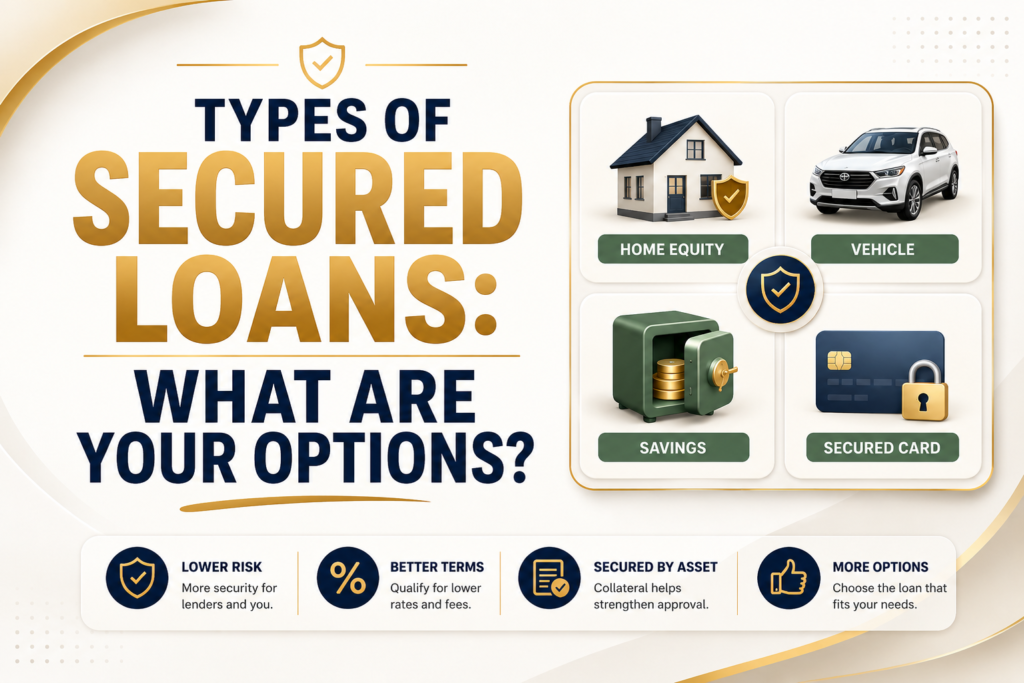
Types of Secured Loans for Bad Credit
Secured borrowing includes several product types.
Some, such as vehicle-secured personal loans, provide installment-loan proceeds. Others, including HELOCs and secured credit cards, use revolving credit.
Savings-Secured Loans
A savings-secured loan uses money in an eligible savings account as collateral.
These loans are commonly offered by banks and credit unions. The institution may require the account to be held in your name and maintained with the same lender.
The lender may restrict the pledged portion of the balance while the loan remains active. Some lenders gradually release portions of the pledged savings as you repay the principal.
The primary risk is reduced liquidity.
The account balance may remain intact, but you may be unable to use the pledged funds for emergencies. This option generally makes more sense when you can restrict part of your savings without eliminating your financial cushion.
Certificate-Secured Loans
A certificate-secured loan uses a certificate of deposit, share certificate, or similar account as collateral.
The lender may consider the certificate’s:
- Ownership
- Balance
- Maturity date
- Existing restrictions
- Eligible borrowing percentage
The certificate may continue earning interest or dividends, depending on the product. You may be unable to redeem or close it while it secures the loan, and the loan term may be limited by its maturity date.
The main risk is reduced access to your money.
Compare the loan’s interest and fees with the certificate’s earnings and any penalty you would pay for withdrawing the funds early.
Vehicle-Secured Personal Loans
A vehicle-secured personal loan uses an eligible vehicle as collateral for an installment loan.
The lender places a lien on the title. You generally continue using the vehicle while making payments, but the lien remains until the loan is repaid and formally released.
Requirements may include:
- Ownership in your name
- A qualifying title
- Current registration
- Required insurance
- Sufficient vehicle value or equity
- Acceptable age and condition
Some lenders require a clear title. Others may consider a financed vehicle when enough equity remains.
Lenders such as OneMain Financial offer secured personal loans using qualifying titled vehicles. Product availability and vehicle eligibility depend on the applicant and lender requirements.
The primary risk is repossession.
That risk deserves particular attention when the vehicle is essential for employment, childcare, education, or medical care.
Having home equity does not guarantee qualification. Home-equity lenders may still apply substantial credit, income, debt, property-value, and ownership requirements.
Home Equity Loans
A home equity loan allows a homeowner to borrow a fixed amount against available home equity.
It generally provides a lump sum repaid through scheduled monthly installments. Many home equity loans use fixed rates, although product terms vary.
Qualification may involve:
- Credit and income review
- Debt-to-income analysis
- Property appraisal
- Title review
- Homeowners insurance
- Closing documents
Home equity loans can support larger borrowing needs, but they may include appraisal, origination, title, and closing costs.
The primary risk is foreclosure.
A home equity loan is secured borrowing, but it is not a secured personal loan. Its underwriting, disclosures, and consequences are tied directly to the home.
Home Equity Lines of Credit
A home equity line of credit, or HELOC, is revolving credit backed by home equity.
Unlike a home equity loan, it does not necessarily provide one fixed lump sum. It gives you access to a credit limit during a defined draw period.
The CFPB explains that a HELOC allows repeated borrowing against home equity.
A HELOC normally has two stages:
- Draw period: You may borrow, repay, and borrow again within the available limit.
- Repayment period: New borrowing ends, and you repay the remaining balance.
Many HELOCs have variable rates. Payments may change when the rate changes or when the account moves into repayment.
The primary risks are rising payments and foreclosure.
A HELOC may fit expenses that occur over time, but it offers less payment certainty than a typical fixed-rate home equity loan.
Secured Credit Cards
A secured credit card requires a refundable cash deposit that protects the issuer.
The deposit often determines or supports the credit limit. A $500 deposit may support a $500 credit line, although policies vary.
The CFPB identifies secured credit cards as one way to establish or rebuild credit history.
A secured card is revolving credit, not an installment loan. You make purchases, receive a statement, and repay at least the required minimum.
Important features include:
- Required deposit
- Credit limit
- Annual and account fees
- Purchase APR
- Credit reporting
- Deposit-refund rules
- Graduation to an unsecured card
The deposit does not normally cover the monthly bill. If the account closes with an unpaid balance, the issuer may apply the deposit under the agreement.
The primary risks are fees, interest, high utilization, missed payments, and loss of the deposit after unpaid debt.
Related Option: Securities-Backed Credit
Securities-backed credit uses eligible investments in a brokerage account as collateral.
This is a specialized product, not a typical bad-credit personal loan.
A securities-backed line of credit is usually revolving rather than a fixed installment loan. FINRA explains that an SBLOC allows investors to borrow against securities held in investment accounts.
The available amount may change as investment values move.
If the portfolio falls below the lender’s required collateral level, the lender may demand additional assets or repayment. It may also sell securities under the agreement.
The main risks are maintenance calls, forced sales, market losses, and possible tax consequences.
This product is generally more appropriate for financially experienced investors than for borrowers seeking a standard bad-credit loan.
Secured Loan Types Compared
| Product Type | Collateral | Credit Structure | Common Purpose | Primary Restriction | Main Risk |
|---|---|---|---|---|---|
| Savings-secured loan | Savings account | Installment loan | General expenses or credit building | Pledged funds may be restricted | Loss of access to emergency savings |
| Certificate-secured loan | Certificate or CD | Installment loan | Borrowing without redeeming the certificate | Funds remain restricted | Reduced liquidity |
| Vehicle-secured personal loan | Eligible vehicle | Installment loan | General personal expenses | Lender lien remains on title | Repossession |
| Home equity loan | Home equity | Lump-sum installment loan | Larger planned expenses | Property lien and closing requirements | Foreclosure |
| HELOC | Home equity | Revolving line of credit | Ongoing or variable expenses | Draw and repayment rules | Rising payments and foreclosure |
| Secured credit card | Cash deposit | Revolving credit card | Small purchases and credit building | Deposit remains held | Fees, interest, and deposit loss |
| Securities-backed credit | Eligible investments | Usually revolving credit | Liquidity without selling investments | Ongoing collateral requirements | Forced sales and market losses |
These products solve different problems.
A secured credit card may help build credit, but it will not replace a large home-repair loan. A HELOC may provide repeated access to funds, but it exposes the home and may use a variable rate. A savings-secured loan may provide predictable payments while restricting emergency funds.
Choose the category before comparing providers.
How to Compare Offers Within Each Category
General measures such as APR, monthly payment, fees, and total repayment still matter.
Each category also has distinct comparison points.
Savings-Secured Loans
Compare:
- Account rate plus lender margin
- Percentage of savings available to borrow
- Whether pledged funds continue earning interest
- Partial-release rules
- Credit reporting
A low rate does not make the loan cost-free. You are paying interest while your own savings remain restricted.
Certificate-Secured Loans
Compare:
- Certificate rate plus lender margin
- Maximum borrowing percentage
- Loan term relative to maturity
- Continued interest or dividend earnings
- Release and early-payoff rules
Compare the borrowing cost with the certificate return and any early-withdrawal penalty you are trying to avoid.
Vehicle-Secured Personal Loans
Compare:
- Vehicle valuation and equity requirements
- Title, lien, and insurance rules
- APR and origination fees
- Net proceeds
- Repossession and lien-release terms
Confirm whether fees are deducted before funding. The approved amount may be higher than the money you receive.
Home Equity Loans
Compare:
- Fixed APR
- Equity and loan-to-value requirements
- Appraisal and closing costs
- Repayment term
- Total repayment
A low advertised rate may be offset by closing expenses. These loans generally make more sense for larger planned needs than for small expenses.
HELOCs
Compare:
- Variable-rate index and margin
- Draw and repayment periods
- Minimum-payment formula
- Rate caps
- Annual and closing fees
The CFPB notes that HELOC disclosures should explain draw and repayment periods, costs, payment calculations, and potential APR changes.
Estimate payments under more than one rate scenario.
Secured Credit Cards
Compare:
- Required deposit and credit limit
- Annual and account fees
- Purchase APR
- Credit reporting
- Deposit refund and graduation policy
A card intended for credit building should report account activity and avoid unnecessary fees.
Securities-Backed Credit
Compare:
- Eligible securities and advance rate
- Variable interest rate
- Maintenance requirements
- Lender liquidation rights
- Restrictions and account fees
The central question is whether you could meet a collateral demand without selling investments during a market decline.

Which Type May Fit Your Situation?
The right secured product depends on the asset available, the purpose of the borrowing, and the repayment structure that fits the need.
Use the situations below to narrow the category before comparing lenders and specific offers.
When Savings Are Available to Pledge
A savings-secured loan may fit when you have enough cash to support the debt, prefer fixed installments, and can temporarily restrict the pledged amount.
Caution: Do not restrict so much savings that an ordinary emergency would require another loan.
Borrowing Against a Certificate
A certificate-secured loan may fit when you want to avoid early withdrawal and the proposed repayment term aligns with the certificate’s maturity date.
Caution: Preserving the certificate may not be worthwhile if the loan’s interest and fees substantially exceed the account return.
Using a Vehicle as Collateral
A vehicle-secured personal loan may fit when you need installment-loan proceeds and have enough vehicle value or equity to meet the lender’s requirements.
Caution: Pledging an essential vehicle can threaten your ability to work or meet daily responsibilities if repayment fails.
Financing a Large Planned Expense
A home equity loan may fit a substantial, defined expense when fixed payments are preferred and the expected benefit justifies the closing process.
Caution: The home secures the debt, so repayment failure can threaten housing.
Covering Costs That Arise Over Time
A HELOC may fit when expenses occur in stages and repeated access to available credit is more useful than receiving one lump sum.
Caution: Variable rates and the transition into the repayment period can increase the required payment.
Building Credit With Smaller Purchases
A secured credit card may fit when the goal is establishing payment history through manageable purchases rather than obtaining a large amount of cash.
Caution: High balances, fees, and missed payments can undermine the credit-building purpose.
Accessing Liquidity Without Selling Investments
Securities-backed credit may fit an experienced investor who needs liquidity and can manage variable rates, maintenance requirements, and market-based collateral risk.
Caution: A market decline may trigger a forced sale when investment values are already lower.
No category is automatically appropriate simply because the collateral is available.
The stronger option is the one that matches the borrowing purpose, repayment preference, and level of collateral risk the borrower can reasonably manage.
When a Secured Loan May Be Too Risky
Collateral can make credit available without making the debt appropriate.
A secured product may be too risky when:
- The asset is essential to housing, employment, transportation, or emergencies.
- The payment works only if every month goes as planned.
- Fees substantially reduce the net proceeds.
- The loan covers recurring bills rather than a defined need.
- You would need another loan after a modest setback.
- The rate or payment could change beyond what you can afford.
- The collateral-release process is unclear.
- The lender will not explain its rights after missed payments.
- The product creates a larger risk than the expense it is intended to address.
Consider the practical outcome, not only the asset’s value.
Restricted savings, loss of a work vehicle, and foreclosure are different consequences. The appropriate category is one whose repayment structure and collateral exposure fit the need without threatening basic stability.
For a deeper decision framework, see our guide to when better secured-loan terms may be worth the collateral risk.
Alternatives When You Do Not Want to Pledge Collateral
Unsecured Personal Loans
An unsecured personal loan does not require a specific pledged asset. It may be safer when you qualify for manageable terms, although damaged credit can limit availability or increase the cost.
Credit Union Small-Dollar Loans
Some credit unions offer smaller installment loans to eligible members. These may address a limited need without requiring a vehicle, home, or substantial deposit account.
Co-Signed Loans
A co-signer may support an application when the lender permits it. The co-signer becomes responsible for repayment and can face credit damage if payments are missed.
Payment Plans and Hardship Programs
Medical providers, utilities, creditors, landlords, and service companies may offer payment plans, due-date changes, or hardship arrangements.
Employer, Nonprofit, or Local Assistance
Some employers, community organizations, and local agencies help with essential expenses such as utilities, transportation, food, rent, or medical costs.
Availability varies, but assistance may be safer than exposing an essential asset.
Conclusion
Secured borrowing is not one uniform product.
Savings-secured and certificate-secured loans restrict deposit accounts. Vehicle-secured personal loans place a lien on transportation. Home equity loans provide fixed lump sums, while HELOCs offer revolving access to home equity. Secured credit cards are commonly used for smaller purchases and credit building. Securities-backed credit creates separate market-related risks.
Choose the category before choosing the lender.
Start with four questions:
- What asset can you reasonably pledge?
- Do you need a lump sum, repeated access, or a credit-building account?
- What costs and restrictions are specific to that product?
- What would happen if the asset became unavailable or the lender enforced its rights?
The right category should match the borrowing need, repayment structure, and level of collateral risk your finances can reasonably absorb.
Frequently Asked Questions
What Is the Easiest Type of Secured Loan to Get With Bad Credit?
A savings- or certificate-secured loan may have simpler qualification requirements when the lender already holds enough funds as collateral.
Eligibility still depends on the institution, account ownership, available balance, and product rules.
Which Secured Loan Type Usually Has the Lowest Rate?
Deposit-secured loans may offer relatively low pricing because cash or a certificate supports the balance.
The actual cost depends on the lender’s margin, account rate, fees, and repayment term.
Is a Savings-Secured Loan Better Than a Vehicle-Secured Loan?
It depends on which consequence is easier to manage.
A savings-secured loan restricts access to cash. A vehicle-secured loan puts transportation at risk. Compare both the cost and the practical effect of losing access to the asset.
Can I Get a Secured Loan Without a Clear Vehicle Title?
Possibly.
Some lenders require a clear title. Others may accept a financed vehicle when enough equity remains. The lender will review the existing lien, title status, and vehicle value.
Is a Home Equity Loan a Secured Personal Loan?
No.
A home equity loan is secured borrowing backed by the home, but it is a mortgage-related product rather than an ordinary secured personal loan.
Is a HELOC the Same as a Home Equity Loan?
No.
A home equity loan generally provides one lump sum. A HELOC is revolving credit that allows repeated borrowing during a draw period.
Does a Secured Credit Card Provide Cash Like a Loan?
Not usually.
A secured card provides a revolving credit line for purchases. Cash advances may be available, but they can carry separate fees and higher interest costs.
Can a Secured Loan Help Rebuild Credit?
It may help when the lender reports account activity and you make payments on time.
Confirm whether the lender reports the product and which credit bureaus receive the information.
What Happens to Collateral After the Loan Is Repaid?
The lender should release its lien or account restriction after the debt is fully paid.
The timing depends on the asset. Deposit restrictions may be removed internally, while vehicle-title or property liens may require additional processing.
Can I Use Jointly Owned Property as Collateral?
Possibly, but the lender may require consent and signatures from every owner.
Joint ownership can complicate approval, lien placement, and enforcement.
Which Secured Loan Type Is Riskiest?
There is no universally riskiest category.
The severity depends on how much you rely on the asset. Home-backed debt can threaten housing, vehicle-backed debt can threaten transportation, and deposit-secured debt can restrict emergency funds.
What Should I Compare Before Choosing a Secured Loan Category?
Compare:
- The collateral required
- How the funds are provided
- APR and fees
- Net proceeds
- Monthly payment
- Repayment structure
- Credit reporting
- Asset restrictions
- Default consequences
- Lien or deposit-release rules

0 Comments