Getting prequalified for a personal loan can feel like a positive sign. You’ve provided some financial information, received an estimated offer, and decided to move forward. Then the lender reviews your full application and denies it.
If your personal loan was denied after prequalification, the decision may come down to information the lender couldn’t verify, additional debt obligations, or details discovered during the final credit review.
Prequalification is not a promise of approval. Understanding what changed between the preliminary assessment and the final decision can help you identify the reason for rejection and decide what to do next.
Key Takeaways
- Prequalification does not guarantee approval. A preliminary offer may be based on limited information that still needs to be verified during underwriting.
- Your financial information may look different after verification. Credit history, qualifying income, existing debts, and application discrepancies can affect the final lending decision.
- The denial notice is your best starting point. A lender generally must identify the principal reasons for rejecting a completed credit application or explain how to request them.
- Some problems are easier to correct than others. Missing documents or inaccurate information may have a different solution than insufficient income or excessive debt.
- Reapplying immediately may not help. Understanding and addressing the original rejection can prevent unnecessary applications and additional credit inquiries.
Disclosure: This site may contain affiliate links. We may receive compensation if you use certain links, at no additional cost to you. Compensation does not determine our editorial conclusions or lender selections.

Why Can You Be Denied After Prequalifying for a Personal Loan?
Prequalification is an initial assessment of whether you might meet a lender’s borrowing requirements. It typically involves sharing basic financial details and, in many cases, allowing a soft credit inquiry.
Based on that information, the lender may provide an estimated loan amount, interest rate, or repayment term.
However, the preliminary assessment does not necessarily include every verification step required for final approval.
When you submit a formal application, the lender may examine your complete credit history, verify your income, evaluate existing financial obligations, and confirm your identity.
Information uncovered during this process can change the decision.
For example, imagine someone prequalifies for a $12,000 loan after reporting $5,000 in monthly income. During underwriting, the lender determines that only part of that income meets its verification requirements. If the verified amount is insufficient to support the requested payment, the application may be denied even though the borrower initially qualified for an estimated offer.
The distinction matters because prequalification reflects preliminary eligibility, while approval depends on the lender’s completed assessment.
Lenders also use the terms prequalified and preapproved differently. Neither term, by itself, guarantees that a personal loan will be funded.
SoFi’s explanation of personal loan underwriting confirms that borrowers can be denied after prequalification when the final review identifies repayment or eligibility concerns.
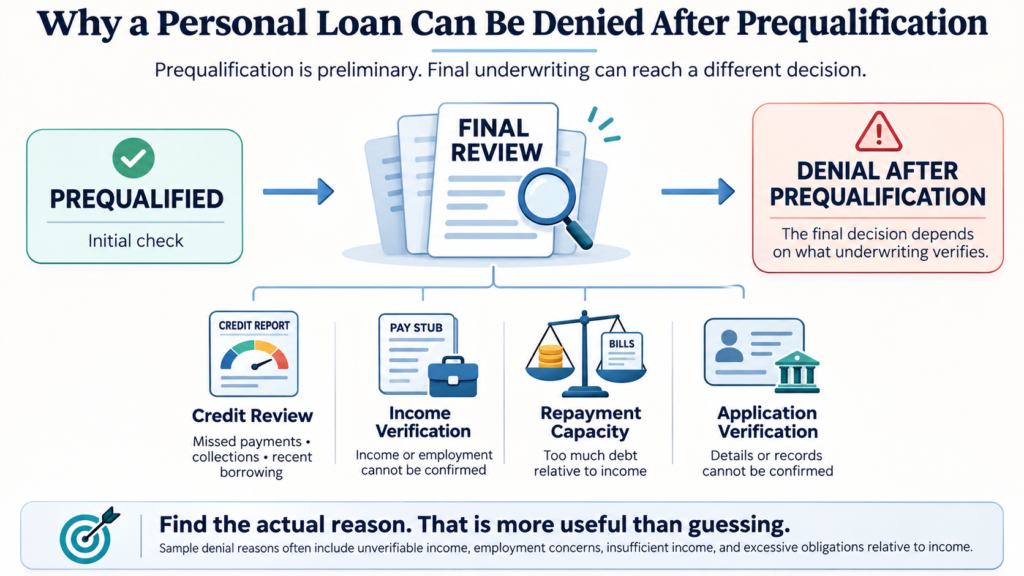
What Can Cause a Personal Loan Denial After Prequalification?
Several factors can explain why an encouraging preliminary result turns into a rejection. The important question is not whether any of these problems could apply to you, but which ones actually influenced the lender’s decision.
Credit History Raises Concerns During the Final Review
An initial eligibility check may not capture everything the lender eventually considers.
During underwriting, the creditor might identify missed payments, collection accounts, high credit card balances, or recent borrowing activity that affects its assessment of your financial risk.
Even a borrower with a relatively strong credit score may fail to meet a particular lender’s requirements.
Creditworthiness involves more than one number. The length and composition of your credit history, existing obligations, and recent account activity may also influence the decision.
A change in your credit profile between prequalification and the formal application can matter as well.
For instance, taking on additional debt after receiving a preliminary offer may affect your eligibility when the lender conducts its final review.
Income or Employment Fails Verification
Stating your income on an application and proving that income are two different steps.
A lender may request pay stubs, bank statements, tax returns, or other documentation to confirm that you have the financial capacity to repay the loan.
Problems can arise when the documents do not match the information originally reported.
Someone who earns commissions, receives irregular payments, or works independently may have income that is more difficult to verify using standard employment records. That does not automatically make the person ineligible, but the lender may need additional documentation or apply specific income-calculation rules.
In other situations, the employer cannot be reached, the records are incomplete, or the verified income is lower than the amount used during prequalification.
The resulting denial may reflect a verification issue rather than a complete lack of earnings.
Existing Debts Leave Too Little Room for Another Payment
Lenders often consider whether a borrower can reasonably manage another monthly obligation.
One common measure is the debt-to-income ratio, which compares recurring monthly debt payments with gross monthly income.
For example, consider a borrower earning $4,000 per month before taxes who already pays $1,600 toward existing debts. Those obligations represent a 40% debt-to-income ratio before adding the proposed personal loan payment.
The lender may determine that another installment would create too much repayment risk under its underwriting standards.
A different requested amount could produce a different assessment, although a smaller loan does not guarantee approval.
Importantly, a good credit score does not eliminate the need to demonstrate repayment capacity.
Application Details Cannot Be Confirmed
Not every rejection is caused by a borrower’s credit or income level.
Some applications fail because essential information cannot be verified.
Possible issues include:
- A name, address, or date of birth that does not match the records used for verification.
- Missing, expired, or unacceptable identification documents.
- Incomplete financial records.
- Inconsistencies between application details and supporting information.
- Difficulty confirming ownership of a linked bank account.
These problems may require clarification or additional documentation. Whether the original application can be reconsidered depends on the lender’s procedures and the reason for the decision.

How to Find Out Why Your Personal Loan Was Denied
Trying to identify the reason through guesswork can lead to unnecessary changes or repeated applications.
A better starting point is the information the lender provides about its decision.
Review Your Adverse Action Notice
When a creditor denies a completed credit application, federal law generally requires an adverse action notice.
This notice must provide the principal reasons for the decision or explain how to request them.
Depending on the circumstances, the reasons may involve income, credit history, outstanding obligations, or another eligibility requirement.
If the notice instructs you to request a statement of reasons, you generally have 60 days after receiving the notification to make that request. The creditor must then provide the statement within 30 days after receiving a timely request.
Read the notice carefully before contacting another lender.
A rejection attributed to unverifiable income calls for a different response than one based on excessive debts or previous payment problems.
The CFPB explains the rights associated with credit application denials, including access to the reasons for a decision and additional protections when a consumer report was used.
Check Your Credit Report for Errors
If the lender relied on information from a consumer reporting agency, the notice should identify that agency and explain your right to request a free copy of the report.
You generally have 60 days after receiving the adverse action notice to request this additional free report.
Review the information that may have affected the application, paying particular attention to account balances, payment histories, collections, and accounts you do not recognize.
Finding a credit score lower than expected does not necessarily mean an error occurred. However, inaccurate account details or outdated information can affect how lenders evaluate your application.
If you identify incorrect information, dispute it with the credit reporting company and the business that supplied the information.
According to the CFPB’s credit report dispute guidance, credit reporting companies generally have 30 days to investigate disputes, although certain circumstances allow additional time.
Contact the Lender for Clarification
A denial notice provides the starting point, but you may still have questions about what happened.
Contacting the lender can be especially useful when the decision involved missing documents, identity verification, or inconsistent financial information.
Rather than simply asking why you were rejected, focus on questions that could clarify your next move:
- Was the application denied because I did not meet an eligibility requirement or because information could not be verified?
- Is there a specific document or discrepancy that needs attention?
- Can the application be reconsidered with additional information?
- Would reconsideration require another credit inquiry?
- If I need to apply again, does the lender have a waiting period?
The lender may not disclose every detail of its internal underwriting model. Still, understanding the stated reasons and available reconsideration procedures can help you avoid repeating the same problem.
What Should You Do Before Applying for Another Personal Loan?
The appropriate next step depends on the actual reason for denial.
Some issues involve records that can be corrected. Others may require changes to your financial circumstances before borrowing becomes realistic.
Reason for denial vs. What to consider before reapplying
| Reason for denial | What to consider before reapplying |
|---|---|
| Inaccurate credit information | Review the report, dispute verified errors, and check whether corrections have been reflected. |
| Income could not be verified | Ask which records were missing or inconsistent and whether acceptable documentation can resolve the issue. |
| Existing debt obligations were too high | Review your monthly obligations and whether your budget can support another payment. |
| Application details did not match | Confirm the accuracy of your personal and financial information and ask about reconsideration. |
| Income was insufficient for the requested amount | Reassess the loan amount, repayment affordability, and the lender’s eligibility requirements. |
The table identifies possible responses, not guaranteed solutions. A lender can still decline an application after a discrepancy is resolved.
Consider the difference between two borrowers.
One has sufficient income but submitted documents that do not clearly show the source or frequency of payments. That person may be able to clarify the information if the lender permits reconsideration.
Another borrower has accurate financial records but already carries substantial monthly debt. Submitting the same application with better-organized paperwork will not change those financial obligations.
The reason for rejection should determine the response, not the desire to get approved as quickly as possible.
Should You Reapply Right Away or Wait?
There is no universal waiting period that makes another personal loan application more likely to succeed.
The decision depends on why you were denied, whether the problem has been resolved, and the requirements of the lender you’re considering.
When Another Application May Make Sense
Reapplying may be reasonable when a correctable issue has been resolved and your financial circumstances still support the loan.
For example, you might have updated missing documentation, corrected an application error, or confirmed that a disputed credit report entry has been fixed.
It may be worth asking the original lender whether reconsideration is available before starting a new application.
You could also evaluate another lender, since underwriting standards vary. However, qualifying with one institution after being denied by another is possible, not certain.
Compare the proposed APR, fees, repayment term, and monthly payment rather than focusing exclusively on eligibility.
When Waiting May Be the Better Decision
If the denial involved insufficient income, substantial debt, or a history of missed payments, another application may produce a similar result until your circumstances change.
Waiting could allow time to reduce balances, establish more stable income, correct financial records, or improve your payment history.
There is an additional reason to be deliberate about repeated applications: credit inquiries.
Many lenders use soft inquiries during prequalification, which do not affect credit scores. A completed application may involve a hard inquiry, which can affect your score even if the loan is denied.
The CFPB’s explanation of credit inquiries distinguishes these two types of checks and their effects on credit reporting.
Before submitting another formal application, confirm whether the lender will conduct a hard inquiry and whether the original reason for denial has been adequately addressed.
Disclosure: This site may contain affiliate links. We may receive compensation if you use certain links, at no additional cost to you. Compensation does not determine our editorial conclusions or lender selections.
Conclusion: Understand the Denial Before Applying Again
Being denied a personal loan after prequalification can be confusing because the preliminary result suggested that borrowing was possible.
But an initial eligibility assessment and a final lending decision are not the same thing. Additional verification may uncover information that changes how a lender evaluates the application.
The most useful response is to identify the actual reason for rejection, determine whether it can be corrected, and evaluate whether another application makes financial sense.
A denial from one lender does not mean every lender will reject you. It also does not mean another application is necessarily the right move.
Understanding what prevented approval gives you a more reliable basis for deciding what comes next.
Frequently Asked Questions
Does Being Denied a Personal Loan Hurt Your Credit Score?
A loan denial does not directly affect your credit score. However, the hard credit inquiry associated with a formal application may have an impact.
If the lender only performed a soft inquiry during prequalification, that check would not affect your score.
Can Another Lender Approve You After One Lender Denies You?
Yes. Lenders have different eligibility requirements and underwriting standards, so a rejection from one does not automatically mean another will deny your application.
However, unresolved problems involving income, credit history, or existing debt may affect your chances elsewhere. Review the original denial reason before applying again.
Could Applying for a Smaller Personal Loan Improve My Chances?
Possibly. A smaller loan may result in a lower monthly payment, which could make the debt easier to manage within your income and existing financial obligations.
Approval still depends on the lender’s requirements and your overall financial situation. Reducing the requested amount does not guarantee a different decision.

0 Comments