Introduction
Bad credit does not automatically prevent you from qualifying for a secured personal loan.
You may still have options if you can provide collateral the lender accepts, document enough income to support the payment, and show that the new debt fits your budget.
A secured personal loan uses an asset or account to support the debt. Common examples include savings accounts, certificates, and qualifying vehicles. The collateral may broaden your borrowing options, but it also creates a direct risk. If you do not repay according to the agreement, the lender may restrict, claim, or repossess the pledged asset.
This guide explains what lenders may review, how to strengthen your application, how to compare offers, and when approval may still lead to an unaffordable loan.
Key Takeaways
- Bad credit does not automatically disqualify you, but lenders may still evaluate your income, existing debts, credit history, collateral, and ability to repay.
- Collateral may strengthen an application, but it does not guarantee approval, a lower APR, or better loan terms.
- Savings accounts, certificate accounts, and qualifying vehicles are common collateral options, although each lender sets its own requirements.
- Strong documentation can help a lender verify your identity, income, collateral ownership, and repayment capacity.
- Approval does not prove that a loan is affordable. Compare the payment, fees, net proceeds, total repayment, and collateral consequences before accepting an offer.
- Avoid lenders that guarantee approval, demand payment before funding, conceal important terms, or request unexplained access to collateral or financial accounts.
- Alternatives may be safer when the payment is difficult, the collateral is essential, or the loan would only postpone a recurring financial problem.
Disclosure: This site may contain affiliate links. We may receive compensation if you use certain links, at no additional cost to you. Compensation does not determine our editorial conclusions.
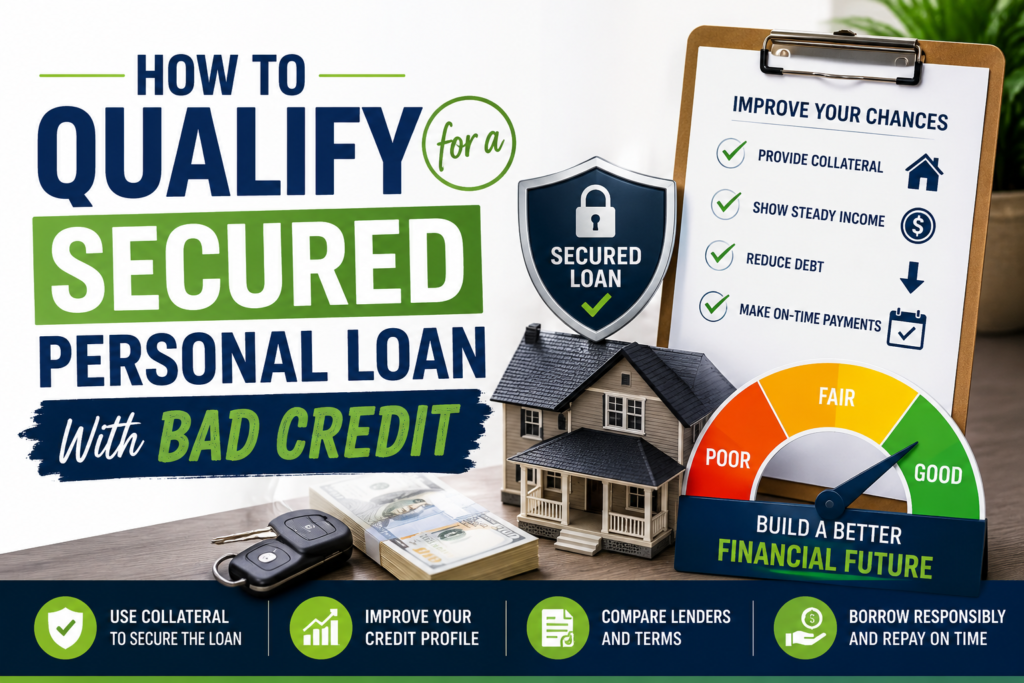
Why Collateral May Broaden Your Loan Options
A secured personal loan is supported by collateral.
Instead of relying only on your credit history and income, the lender also receives a claim against an eligible asset or account. That claim may reduce part of the lender’s risk if the loan is not repaid.
For someone with bad credit, collateral may:
- Broaden the lenders or products available
- Support a larger approved amount
- Help offset weaknesses elsewhere in the application
- Contribute to different pricing or repayment terms
None of these outcomes is guaranteed.
A lender may still review:
- Income
- Existing debt
- Payment history
- Recent credit activity
- Collateral ownership
- Collateral value
- Existing liens
- Ability to afford the payment
Some deposit-secured credit-union products may have different underwriting rules and may not require a conventional credit check. Requirements vary by lender.
Collateral changes the lender’s protection. It does not remove the need for an affordable repayment plan.
If you fall behind, the lender may eventually enforce its rights against the asset. The exact process depends on the loan agreement, collateral type, and applicable law.

Secured Personal Loan Options for Bad Credit
The right option depends on which assets the lender accepts and which risks you can reasonably manage.
Compare whether the asset qualifies, what documentation is required, how access changes during repayment, and what is primarily at risk. Review whether the asset qualifies, what documentation is required, how access changes during repayment, and what is primarily at risk.
Savings-Secured Loans
A savings-secured loan uses money held in an eligible savings account as collateral.
The lender or credit union may require:
- An account in your name
- A minimum available balance
- Funds held by the same institution
- Authorization to restrict the pledged amount
The money usually remains in the account, but you may not be able to withdraw the pledged portion while the loan is active.
The primary risk is reduced liquidity. Using emergency savings as collateral may leave you with less accessible money when an unexpected expense occurs.
Certificate-Secured Loans
A certificate-secured loan uses an eligible certificate account or certificate of deposit as collateral.
The lender may review:
- Account ownership
- Certificate balance
- Maturity date
- Existing restrictions
- Whether the certificate is held by that institution
The certificate may continue earning interest or dividends, depending on the product. Access to the pledged funds is generally restricted during repayment, and the loan term may be limited by the certificate’s maturity date.
The primary risk is losing financial flexibility while the funds are pledged.
Vehicle-Secured Personal Loans
A vehicle-secured personal loan uses an eligible car, truck, motorcycle, or other approved vehicle as collateral.
The lender may require:
- Clear ownership
- A qualifying title
- Current registration
- Insurance
- Sufficient vehicle value
- No existing lien, or enough equity under its rules
- A vehicle that meets age and condition limits
The lender generally places a lien on the title until the loan is repaid and the lien is released.
The primary risk is repossession. That risk becomes more serious when you rely on the vehicle for employment, childcare, education, or medical care.
How the Collateral Risks Compare
| Collateral | What May Be Required | Restriction During Repayment | Primary Risk |
|---|---|---|---|
| Savings | Eligible account, sufficient balance, verified ownership | Pledged funds may be frozen or unavailable | Loss of access to emergency funds |
| Certificate | Eligible certificate, sufficient balance, acceptable maturity date | Withdrawals may be restricted | Reduced liquidity and maturity limitations |
| Vehicle | Title, registration, insurance, value, and ownership documentation | Lender lien remains on the title | Repossession and loss of transportation |
These risks are not directly equivalent.
Restricted savings may create a liquidity problem. A vehicle lien may place daily transportation at risk. Consider the practical effect of the restriction, not only the asset’s dollar value.
Related Option: Securities-Backed Credit
Some financial institutions offer credit supported by eligible investment accounts.
These products are often structured as securities-backed lines of credit rather than traditional bad-credit personal loans. FINRA describes a securities-backed line of credit as a revolving loan secured by investments in a brokerage account.
The lender may require:
- An eligible brokerage account
- Sufficient qualifying investments
- Ongoing minimum collateral value
- Permission to restrict or sell assets under the agreement
A decline in investment value may lead to a demand for additional collateral, partial repayment, or the sale of securities.
Because these products are specialized and depend on investment assets, they are not a common solution for most borrowers seeking a secured personal loan with bad credit.

What Lenders Review Before Approval
Collateral is only one part of the application.
Most lenders also want evidence that you can make the scheduled payments without immediately falling behind.
Acceptable Collateral
The lender first determines whether the asset meets its product rules.
It may evaluate:
- Asset type
- Ownership
- Current value
- Existing liens
- Account location
- Insurance
- Vehicle age or condition
- Certificate maturity
An asset may be rejected if it is difficult to verify, already pledged, jointly owned without the required consent, or worth less than the lender requires.
Proof of Income
A lender may ask for evidence of recurring income.
Depending on your situation, that may include:
- Pay stubs
- Bank statements
- Benefit letters
- Tax returns
- Profit-and-loss statements
- Contracts
- Invoices
- Deposit records
Collateral does not replace income. The lender still needs to determine whether your cash flow can support another monthly obligation.
Existing Debt and Monthly Obligations
Your current payments affect how much room remains in your budget.
The lender may consider obligations such as:
- Credit card minimum payments
- Auto loans
- Student loans
- Other personal loans
- Housing costs
- Court-ordered payments
A high level of existing obligations may result in a smaller offer, different terms, or a denial even when the collateral is acceptable.
Credit History
Bad credit does not always prevent approval, but lenders may still review what caused the low score.
They may consider:
- Missed payments
- Collections
- Charge-offs
- Defaults
- Recent applications
- Current delinquencies
- Length of credit history
A past problem may be viewed differently from an account that is currently unpaid.
Some lenders use proprietary underwriting systems and do not publish a minimum score.
Supporting Documents
Prepare documents that verify both the borrower and the collateral.
Common requirements include:
- Government-issued identification
- Proof of address
- Income documentation
- Bank or account statements
- Vehicle title
- Registration
- Insurance records
- Certificate details
- Existing loan information
Complete and consistent documentation can reduce delays. It does not guarantee approval.

How to Strengthen Your Application
A focused application is generally better than applying broadly without checking the lender’s requirements.
Check Your Credit Reports
Review your reports before applying so you know what a lender may see.
Look for:
- Incorrect balances
- Duplicate accounts
- Outdated negative information
- Accounts you do not recognize
- Incorrect payment statuses
- Personal information errors
You can request free weekly reports from Equifax, Experian, and TransUnion through AnnualCreditReport.com, the federally authorized source for free credit reports.
Correcting an error does not guarantee a score increase or approval. It can prevent a lender from evaluating your application using inaccurate information.
Match the Collateral to the Lender
Confirm that the lender accepts the asset before applying.
A lender offering savings-secured loans may require the account to be held at that institution. A vehicle-secured lender may reject older vehicles, financed vehicles, commercial vehicles, or titles with ownership problems.
Applying to a lender that does not accept your collateral wastes time and may create an unnecessary credit inquiry.
Reduce Monthly Debt Where Possible
Focus on obligations that affect monthly cash flow.
Paying off or refinancing a debt may help only if it actually reduces the required monthly payment. A lower account balance does not automatically create a lower debt-to-income ratio.
Do not use emergency savings or miss essential bills simply to improve an application.
Gather Documents Before Applying
Collect the likely requirements before starting.
Check that:
- Names match across documents
- Addresses are current
- Income deposits can be explained
- Vehicle ownership is clear
- Insurance is active
- Account balances meet the lender’s rules
Clear documentation may make verification easier.
Prequalify When Available
Some lenders allow you to review estimated offers before completing a full application.
Prequalification may use a soft credit inquiry, but practices vary. Confirm the inquiry type before submitting information. The CFPB explains that soft inquiries generally do not affect credit scores, while a full application may involve a hard inquiry.
Prequalification is not final approval. The rate, amount, or term may change after verification.
Request Only What You Need
Do not treat the largest available approval as the target.
A larger loan can mean:
- A higher payment
- More interest
- Greater fees
- A longer repayment period
- More collateral exposure
Estimate the actual expense and request an amount that solves that need without adding unnecessary debt.

How to Compare Secured Loan Offers
Approval is only the beginning of the comparison.
Use the same criteria for each offer.
| Factor | What to Review |
|---|---|
| APR | Annualized borrowing cost, including certain fees |
| Fees | Origination, title, account, documentation, or administrative charges |
| Net proceeds | Amount received after deducted fees |
| Monthly payment | Whether it fits normal cash flow |
| Repayment term | Effect on the payment and total interest |
| Total repayment | Full amount expected over the loan term |
| Credit reporting | Whether payments are reported and to which bureaus |
| Collateral terms | What the lender may restrict, hold, or claim |
| Default provisions | What happens after missed payments |
| Release process | When the lien or account restriction ends |
The interest rate alone does not show the full cost. The CFPB explains that APR reflects the interest rate plus additional loan fees.
Compare Net Proceeds
An origination fee may be deducted from the loan before funding.
For example, a $5,000 loan with a $300 deducted fee provides $4,700 in net proceeds, even though repayment may be based on the full amount financed.
Make sure the proceeds are enough for the intended expense.
Compare the Full Repayment Term
A longer term may lower the monthly payment while increasing total interest.
Compare offers over similar terms whenever possible.
A three-year loan and a five-year loan are not directly equivalent simply because one has a lower monthly payment.
Confirm Credit Reporting
A secured loan may help establish positive payment history only when the lender reports the account.
Ask:
- Whether it reports payments
- Which credit bureaus receive the information
- How frequently reporting occurs
- Whether late payments are also reported
Do not assume every secured lender reports to all three major bureaus.
Understand the Release Process
The agreement should explain how the lender releases its lien or restriction after payoff.
Confirm:
- Whether release is automatic
- How long processing may take
- Whether the borrower must request documentation
- When restricted funds become available
- How a vehicle-title lien is removed
Keep your payoff records until the lender confirms that its lien or account restriction has been released.
Warning Signs to Avoid
Bad credit can make quick approval feel urgent. That urgency can also make risky offers more persuasive.
Guaranteed Approval Claims
Be cautious when a lender promises approval before reviewing your application.
A responsible lender may consider the collateral, income, debt, identity, and repayment capacity before making a final decision.
“Guaranteed approval” may be used to attract borrowers to expensive products or scams.
Upfront Payment Requests
Do not pay someone in advance for a promised loan.
The FTC warns that advance-fee loan scams often target people with bad credit and request processing, insurance, application, or other payments before providing funds.
Avoid requests involving:
- Wire transfers
- Gift cards
- Prepaid debit cards
- Cryptocurrency
- Cash payments
- Payment to an individual rather than a verified company
A legitimate origination fee may be disclosed as part of a real loan agreement and deducted from the proceeds. That is different from paying an unknown party before approval or funding.
Requests for Collateral Access Before Clear Approval
A lender may need to verify collateral and prepare a legitimate lien after presenting clear terms.
The warning sign is premature, unexplained, or excessive access.
Be cautious when someone requests:
- A signed title transfer before providing final terms
- Online banking credentials
- Brokerage login information
- Blank authorization forms
- Remote access to your phone or computer
- Control of an account unrelated to the collateral
- Sensitive documents through an unverified channel
The lender should explain what information it needs, why it is necessary, and how it will be protected.
Vague Loan Terms
Do not accept an offer without written terms.
The agreement should clearly state:
- APR
- Fees
- Net proceeds
- Monthly payment
- Due dates
- Repayment term
- Collateral
- Default provisions
- Lien or restriction
- Release process
Pause when the lender changes the terms late in the process or refuses to answer direct questions.
Unnecessary Add-Ons
Some lenders offer optional products such as:
- Credit insurance
- Debt-cancellation products
- Monitoring services
- Membership plans
- Roadside assistance
- Other subscription services
An optional product can increase the amount financed or reduce net proceeds.
Ask whether each product is required. Decline it when the cost does not provide clear value.
When Approval Does Not Mean the Loan Is Affordable
Qualifying for a secured personal loan does not mean the offer is affordable, competitive, or appropriate.
Collateral may make a lender more willing to approve the application because an asset supports the debt. That protection benefits the lender. It does not prove that the payment fits your finances.
Before accepting, evaluate the loan against an ordinary month, not an ideal one.
Include:
- Housing
- Utilities
- Food
- Transportation
- Insurance
- Medical costs
- Existing debt
- Irregular expenses
- Emergency savings
A loan that leaves no room for normal variation may place the collateral at unnecessary risk.
Signs the Loan May Be Manageable
A secured personal loan may be manageable when:
- The payment fits your budget during an ordinary month.
- Essential expenses remain affordable.
- The net proceeds are enough for the intended need.
- The total repayment compares reasonably with available alternatives.
- The loan addresses a specific expense.
- The collateral rules are clear.
- Restricting or losing the collateral would not create an immediate crisis.
- You have some ability to handle an unexpected expense or temporary income reduction.
These conditions do not guarantee that the loan is the best option. They indicate that the offer may deserve further consideration.
Signs the Offer May Be Too Risky
Pause when:
- The payment works only if every month goes as planned.
- Fees substantially reduce the net proceeds.
- The term lowers the payment but makes total repayment excessive.
- You must pledge your only reliable vehicle.
- You must restrict all or most of your emergency savings.
- The loan covers bills that will return next month.
- You are borrowing to make payments on other debts.
- You would need another loan after a small financial setback.
- The lender emphasizes the approved amount but not the total cost.
- The default or release provisions are unclear.
Approval answers whether the lender is willing to provide the money.
Affordability answers whether repaying the loan is likely to improve your position without creating an unreasonable risk to an asset you depend on.
Alternatives to Secured Personal Loans
A secured personal loan is not the only option when credit is damaged.
The appropriate alternative depends on whether you need immediate funds, lower payments, help rebuilding credit, or assistance with a specific bill.
Credit-Builder Loans
A credit-builder loan is designed primarily to establish payment history.
The lender commonly holds the loan proceeds in an account while you make scheduled payments. You receive the funds after completing the repayment period, subject to the product terms.
This may help when the goal is future credit improvement.
It usually does not solve an immediate cash need.
Credit Union Small-Dollar Loans
Some credit unions offer small installment loans with defined payment schedules.
Federal credit unions may also offer Payday Alternative Loans. PAL products are subject to NCUA rules, but individual credit unions decide whether to offer them. Current federal rules allow qualifying PAL rates up to 28%.
Membership, loan amount, fee, and repayment requirements vary.
Compare the full cost rather than assuming every credit-union product is inexpensive.
Co-Signed Personal Loans
A co-signer with stronger credit may support an application when the lender permits co-signers.
The co-signer becomes legally responsible for repayment. Missed payments may affect both people’s credit, and the lender may seek payment from the co-signer.
Use this option only when both people understand the full agreement and repayment risk.
Payment Plans and Hardship Programs
Contact the organization you need to pay before taking out a loan.
Depending on the bill, you may be able to request:
- A payment plan
- A due-date adjustment
- A temporary hardship arrangement
- Reduced monthly payments
- A fee waiver
- A settlement arrangement
Medical providers, utilities, creditors, landlords, insurers, and service providers may have different policies.
Assistance is not guaranteed, but asking may reduce the amount you need to borrow.
Employer, Nonprofit, and Local Assistance
Some employers, nonprofits, religious organizations, and local agencies offer support for essential expenses.
Programs may help with:
- Rent
- Utilities
- Food
- Transportation
- Medical expenses
- Emergency travel
- Short-term hardship
Availability and eligibility vary by location.
Non-loan assistance may be preferable when borrowing would only create another unaffordable payment.

Conclusion
You may be able to qualify for a secured personal loan with bad credit when you have acceptable collateral, documented income, and enough room in your budget for the payment.
Collateral can broaden your options. It can also expose savings, certificates, or transportation to restrictions or loss.
Prepare before applying. Review your credit reports, identify lenders that accept your collateral, gather complete documents, and compare estimated offers where available.
Then evaluate the full loan rather than the approval alone.
Compare the APR, fees, net proceeds, monthly payment, total repayment, credit reporting, default provisions, and collateral-release process.
The right loan is not the largest amount a lender will approve. It is an offer that addresses a defined need without creating a payment or collateral risk your finances cannot reasonably absorb.
Frequently Asked Questions
Can I Get a Secured Personal Loan With Bad Credit?
You may be able to qualify if you have acceptable collateral and sufficient income to manage the payment.
Approval depends on the lender’s rules, your current debts, credit history, collateral value, and repayment capacity.
What Credit Score Is Required?
There is no universal minimum credit score.
Some lenders serve borrowers with damaged credit, while others use higher minimums or proprietary underwriting systems. Deposit-secured products may use different qualification standards.
Do All Secured Lenders Check Credit?
No.
Some savings- or certificate-secured products may not require a conventional credit check. Other lenders may review your complete credit history before approving a vehicle- or asset-secured loan.
What Assets Can Be Used as Collateral?
Common options include eligible savings accounts, certificate accounts, and vehicles.
Each lender determines what it accepts. Ownership, value, existing liens, account location, insurance, and other conditions may apply.
Can I Use a Vehicle That Still Has a Loan?
Possibly, but many lenders require a clear title or enough vehicle equity to satisfy their rules.
The lender will generally review the existing balance, title status, and vehicle value before deciding whether it qualifies.
Can I Qualify With Income That Changes Each Month?
You may qualify with variable income, but the lender may request a longer documentation history.
Self-employed, gig, hourly, seasonal, or commission-based borrowers may need bank statements, tax records, contracts, invoices, or several months of income records.
The lender may use an average or otherwise evaluate whether the income is stable enough to support the payment.
Does Prequalification Affect Credit?
It depends on the lender.
Some prequalification processes use a soft inquiry that does not affect credit scores. A full application may involve a hard inquiry. Confirm the inquiry type before proceeding.
Can a Secured Loan Help Rebuild Credit?
It may help when the lender reports payments to one or more credit bureaus and you pay on time.
Ask about credit reporting before accepting the loan. Not every lender reports to all three major bureaus.
How Long Is Collateral Restricted After Payoff?
The timing depends on the lender, collateral type, and processing requirements.
Savings restrictions may be removed after the payment clears. A vehicle-title lien may take longer to release and update with the relevant state agency.
Review the agreement and request written confirmation after payoff.
What Happens If I Miss Payments?
The lender may charge fees, report missed payments, restrict the collateral, or eventually enforce its rights against the asset.
The process depends on the agreement, collateral, and applicable law.
How Can I Avoid Secured Loan Scams?
Avoid companies that guarantee approval, request upfront payment, hide loan terms, demand remote device access, or ask for unexplained account credentials.
Verify the lender, review the written agreement, and do not provide collateral access before receiving clear terms.

0 Comments