Introduction: Know What Lenders Check Before You Risk Your Title
Title loan requirements are usually simple, but that does not make the loan safe. Most lenders want to see that you own the vehicle, can prove your identity, and have some way to repay the loan.
A title loan uses your car, truck, motorcycle, or another vehicle as collateral. The Federal Trade Commission explains that car title loans are short-term loans that often last 15 or 30 days and are usually based on a percentage of the vehicle’s value.
That speed can make title loans tempting when money is tight. But if you cannot repay on time, the lender may charge fees, offer a rollover, or repossess the vehicle. The CFPB found that one in five single-payment auto title loan borrowers had their vehicle seized after failing to repay.
This guide explains the common title loan requirements, what documents lenders may ask for, how credit and income affect approval, and what to check before you hand over your title.
Key Takeaways
- Most title lenders require a vehicle title in your name, a valid ID, proof of residence, and vehicle information.
- Many lenders prefer a clear title, which means the vehicle is paid off and has no existing lien.
- Some lenders ask for proof of income, insurance, vehicle registration, photos, or a spare key.
- Bad credit may not automatically prevent approval because the vehicle secures the loan.
- Approval does not mean the loan is affordable. The repayment amount, fees, APR, and due date matter more than the cash offer.
- State laws and lender rules vary, so always confirm that the lender is licensed where you live.
- Before applying, compare safer options that do not put your vehicle at risk.
Disclaimer: This site contains affiliate links. If you make a purchase, we may earn a commission at no extra cost to you.
What Title Loan Requirements Usually Include
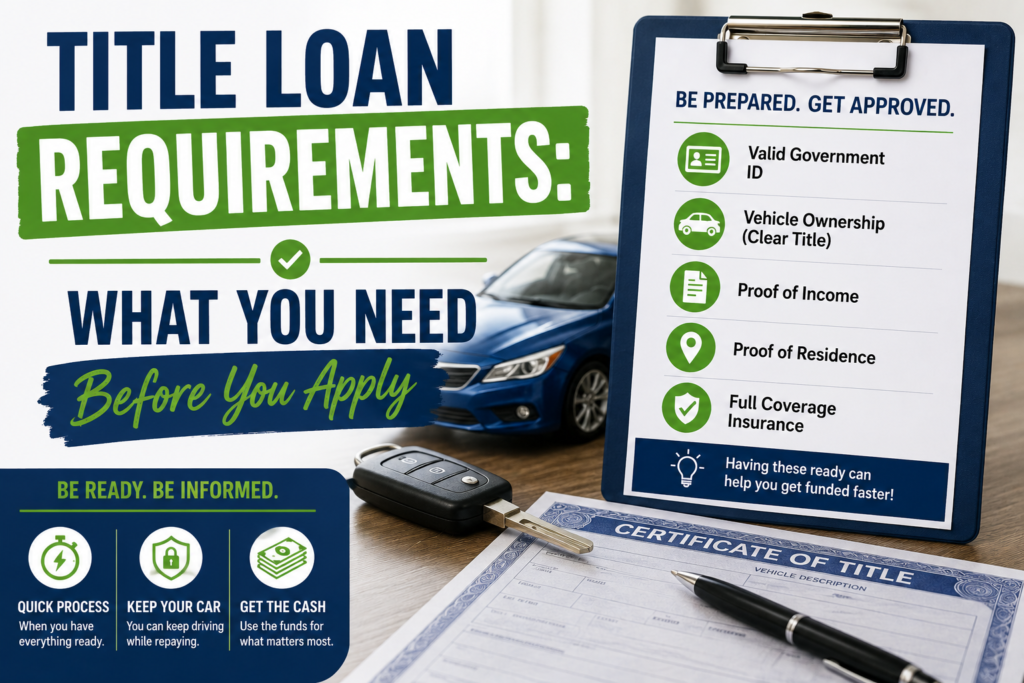
Title loan requirements vary by lender and state, but most lenders ask for the same basic information. They want to confirm that the vehicle exists, the title is valid, and you have a way to repay the loan.
The Federal Trade Commission says lenders typically ask to see the vehicle, a photo ID, and proof of insurance. Many lenders also ask for a duplicate set of keys.
Here are the most common title loan requirements:
- A vehicle title in your name
- A valid government-issued photo ID
- Proof of residence
- Proof of insurance
- Vehicle registration
- Proof of income or regular deposits
- Vehicle photos or an in-person inspection
- A spare key, in some cases
The title is usually the most important requirement. Many lenders prefer a clear title, which means the vehicle is paid off and does not have another lender listed as a lienholder. Some lenders may consider a vehicle that is mostly paid off, but that depends on the lender and your state’s rules.
You should also expect the lender to review the vehicle’s value. The offer may depend on the car’s make, model, year, mileage, condition, and local market demand.
Bottom Line
The basic requirements may look simple, but they still deserve caution. Having the right documents may help you qualify, but it does not mean the loan is affordable or safe.

Why a Clear Vehicle Title Matters
A clear vehicle title is one of the most important title loan requirements because it proves that you own the vehicle and that no other lender has a claim on it.
A title is usually considered clear when:
- Your name is on the title
- The vehicle is paid off
- There are no active liens
- The title is not marked as salvage, rebuilt, or otherwise restricted, depending on lender rules
- The title information matches your ID and vehicle registration
Lenders care about this because the vehicle secures the loan. If there is already a lien on the title, another lender may have the first legal claim to the vehicle. That can make the loan harder to approve or unavailable altogether.
Some lenders may advertise title loans for vehicles that are not fully paid off, but those loans can be more complicated. They may involve higher costs, stricter terms, or refinancing-style arrangements that increase your risk.
Before applying, check your title carefully. Make sure your name, vehicle identification number, and lienholder information are accurate. If something looks wrong, fix it before giving your information to a lender.
Bottom Line
A clear title can make approval simpler, but it also means your vehicle is fully at risk if you default. Do not treat a clear title as a green light to borrow. Treat it as a reminder to review the loan terms carefully before putting your car on the line.

How Vehicle Value Affects Approval
Vehicle value plays a major role in title loan approval because the loan is secured by the car, truck, motorcycle, or other vehicle you use as collateral.
Lenders usually review details like:
- Make, model, and year
- Mileage
- Mechanical condition
- Exterior and interior condition
- Local resale value
- Vehicle history
- Whether the title is clear
The offer is usually only a portion of the vehicle’s value, not the full amount. The Federal Trade Commission says title loans are often for 25% to 50% of the vehicle’s value.
That means a vehicle worth $6,000 may lead to a much smaller loan offer. It also means a lender may approve you for more than you actually need.
That is where borrowers can get into trouble. A higher loan offer may feel helpful, but it can also mean a larger repayment amount, more fees, and a greater risk of default.
Before accepting an offer, compare the loan amount to the actual emergency. If you need $500, do not borrow $1,500 just because the lender offers it.
Bottom Line
Your vehicle’s value affects how much a lender may offer, but it should not decide how much you borrow. Borrow based on what you can safely repay, not on the maximum amount available.
How Credit and Income Affect Title Loan Approval
Title loans are often marketed to borrowers with bad credit because approval depends heavily on the vehicle used as collateral. Instead of focusing only on a credit score, many lenders look at the title, the vehicle’s value, and whether you have a way to repay.
That does not mean credit never matters. Some lenders may still review your credit, even if they do not weigh it as heavily as a traditional bank or credit card issuer would. Others may advertise no-credit-check title loans, but they still usually verify your identity, vehicle ownership, and repayment ability.
Income can also come from different sources, depending on the lender. This may include:
- Wages from a job
- Self-employment income
- Retirement income
- Social Security or disability benefits
- Workers’ compensation
- Regular bank deposits
- Other documented income sources
The important part is consistency. A lender wants to see that money comes in regularly enough to support repayment.
Still, approval is not the same as affordability. A lender may approve the loan because your vehicle has enough value, but the payment may still be too high for your budget.
Before accepting an offer, compare the full repayment amount with your actual cash flow. If paying the loan would force you to miss rent, utilities, insurance, groceries, or another essential bill, the loan is too risky.
Bottom Line
Bad credit or nontraditional income may not prevent approval, but they can make repayment harder if your budget is already tight. Focus less on whether a lender will approve you and more on whether the loan fits your budget without putting your vehicle at risk.

Requirements That Vary by State or Lender
Title loan requirements are not the same everywhere. State laws and lender policies can change what you need to qualify, how much you can borrow, what fees apply, and what happens if you fall behind.
Some states allow title loans with specific rules. Others restrict them heavily or make high-cost title lending difficult to offer. That means a lender’s website may not tell the full story for your location.
Requirements can vary around:
- Whether title loans are available in your state
- Whether the lender must be licensed where you live
- Maximum loan amounts
- APR or fee limits
- Loan term length
- Required insurance
- Clear title rules
- Rollover or renewal limits
- Repossession procedures
- Required disclosures before signing
Federal law also requires lenders to disclose the finance charge and APR in writing before you sign a credit agreement, according to the Federal Trade Commission. That helps you compare the true cost, but you still need to check your state’s rules and the lender’s exact terms.
Online lenders deserve extra caution. A lender may advertise online, but that does not automatically mean it is licensed to make title loans in your state. Before applying, check your state financial regulator, attorney general, or consumer protection office.
Bottom Line
Do not assume title loan requirements are universal. Before sharing personal information or signing an agreement, confirm that the lender is licensed in your state and that you understand the local rules, fees, repayment terms, and repossession risks.
What Can Stop You From Qualifying for a Title Loan?
Even if title loan requirements look simple, some issues can still block approval or make the loan harder to get.
Common reasons a lender may deny or delay a title loan application include:
- The vehicle title is not in your name
- The title has an existing lien
- The vehicle is not paid off
- The title is missing, damaged, or incorrect
- Your ID does not match the title or application
- You cannot prove your address
- You cannot show income or regular deposits
- The vehicle value is too low
- The vehicle condition does not meet the lender’s standards
- Insurance is required, but you do not have active coverage
- The lender does not operate legally in your state
Some of these issues can be fixed. For example, you may be able to replace a missing title through your state motor vehicle agency or correct outdated address information before applying.
Other issues are bigger warning signs. If you do not have enough income to repay the loan, or if the lender is not licensed in your state, it is safer to stop before moving forward.
Be careful with any lender that promises approval no matter what. A real lender still needs to verify your identity, title, vehicle, and repayment ability. Guaranteed approval claims can be a sign of high fees, weak protections, or a risky lender.
Bottom Line
A denied title loan application may feel frustrating, but it can also protect you from a loan that puts your vehicle at risk. If you do not meet the requirements, compare safer options before trying another high-cost lender.

What to Check Before You Hand Over Your Title
Meeting the title loan requirements is only the first step. Before you hand over your title or let the lender place a lien on your vehicle, make sure you understand the full agreement.
Do not rely on a quick approval message or a verbal explanation. Ask for the loan terms in writing and review them carefully before signing.
Check these details first:
- The loan amount
- The finance charge
- The APR
- The due date
- The full repayment amount
- Any late fees
- Rollover or renewal rules
- Repossession terms
- Storage or towing fees after repossession
- Whether the lender reports to credit bureaus
- Whether the lender is licensed in your state
The APR matters because it shows the yearly cost of borrowing, even if the loan lasts only a few weeks. A title loan can look manageable when you focus only on the cash received, but the full repayment amount may tell a different story.
Rollover rules also deserve close attention. The Federal Trade Commission warns that rolling over a car title loan can mean paying new fees while still owing the original loan amount.
If anything is unclear, ask questions before signing. If the lender avoids your questions, pressures you to move fast, or will not provide written terms, walk away.
Bottom Line
Never hand over your title until you understand the total cost, repayment deadline, rollover rules, and repossession terms. A title loan should be clear in writing before your vehicle is used as collateral.

Safer Options If You Do Not Meet the Requirements
If you do not meet the title loan requirements, that may feel like a setback. But it can also be a warning sign that the loan is not the right fit.
A title loan uses your vehicle as collateral, so getting denied may protect you from taking on a loan that could put your transportation at risk. Before trying another title lender, compare safer options that do not require handing over your vehicle title.
Credit Union Personal Loans
A credit union personal loan may be a safer place to start. Credit unions often offer smaller personal loans with lower costs than high-interest title loans.
You may need to become a member, show income, and complete a credit review. Even so, this option may give you more manageable repayment terms without tying the loan directly to your car.
Payday Alternative Loans
Some federal credit unions offer Payday Alternative Loans, also called PALs. These are small-dollar loans designed to give borrowers a safer option than payday loans or other high-cost emergency loans.
The National Credit Union Administration says federal credit unions may charge up to 28% on Payday Alternative Loans under NCUA rules.
Payment Plans With Creditors
If you need money because of a specific bill, contact the company you owe before taking out a title loan.
Medical providers, utility companies, landlords, and other creditors may offer payment plans, hardship programs, due-date extensions, or partial-payment options. These options are not always available, but they may help you solve the problem without risking your vehicle.
Emergency Assistance Programs
Local nonprofits, churches, charities, and government programs may help with rent, utilities, food, transportation, medical bills, or other urgent needs.
These programs may take more effort to find, but they can be much safer than borrowing against your car title.
Borrowing From Someone You Trust
Borrowing from family or friends can be uncomfortable, but it may cost less than a title loan and avoid repossession risk.
If you choose this option, put the terms in writing. Include the amount borrowed, repayment date, and any agreed conditions. Clear terms protect both sides.
Bottom Line
If you do not qualify for a title loan, do not rush to find a riskier lender. Look for a safer way to solve the emergency first.
A denied application is frustrating, but losing your vehicle would be much worse.
Conclusion: Requirements Are Only the First Check
Title loan requirements may be simple, but qualifying is not the same as making a safe borrowing decision.
A lender may approve you if you have a vehicle title, valid ID, proof of residence, insurance, income, and a vehicle with enough value. But those requirements only show that the lender may be willing to offer money. They do not prove that the loan is affordable.
Before applying, look beyond approval. Review the APR, finance charge, full repayment amount, due date, fees, rollover rules, and repossession terms. Then compare the loan with safer options that do not put your vehicle at risk.
If the payment does not fit your budget, pause. If the lender is not licensed in your state, walk away. If the terms are unclear, do not sign.
A title loan should be a last-resort option. The real goal is not just to meet the requirements. It is to protect your transportation, your income, and your financial stability.
Bottom Line: Meeting the title loan requirements can help you qualify, but only a clear repayment plan can help you avoid bigger trouble. Before you use your vehicle as collateral, make sure the loan is legal, affordable, and truly necessary.
Frequently Asked Questions About Title Loan Requirements
What documents do I need for a title loan?
Most lenders ask for a vehicle title in your name, a valid government-issued ID, proof of residence, vehicle registration, and proof of insurance if required.
Some lenders may also ask for proof of income, recent bank statements, vehicle photos, an in-person inspection, or a spare key. Requirements vary by lender and state.
Do I need a clear title for a title loan?
Usually, yes. Most title lenders prefer a clear title, which means the vehicle is paid off and has no active lien from another lender.
Some lenders may advertise options for vehicles that are not fully paid off, but those loans can be more complicated and may carry higher costs or stricter terms.
Can I get a title loan if the title is not in my name?
Usually, no. Most lenders require the title to be in your name because the vehicle is used as collateral.
If the title is in another person’s name, you may need to transfer ownership before applying. Never use someone else’s title without clear legal permission.
Do title loan lenders check credit?
Some do, and some do not. Many title lenders focus more on your vehicle’s value, title status, and repayment ability than your credit score.
Still, “no credit check” does not mean no risk. Even if your credit is not the main factor, you can still lose your vehicle if you default.
Do I need proof of income for a title loan?
Many lenders ask for proof of income or regular deposits. This helps them decide whether you have a way to repay the loan.
Income may come from wages, self-employment, retirement benefits, disability benefits, workers’ compensation, or other documented sources, depending on the lender.
Can I get a title loan without car insurance?
It depends on the lender and your state. Some lenders require active car insurance before approving the loan.
If insurance is required, the lender may also require you to keep coverage active while the loan is open. Letting insurance lapse could violate the loan agreement.
How much can I borrow with a title loan?
The amount usually depends on your vehicle’s value, your title status, your income, and the lender’s rules.
Many title loans are for only a portion of the vehicle’s value, not the full amount. A larger offer does not mean you should borrow more. Borrow only what you can realistically repay.
What can stop me from qualifying for a title loan?
Common issues include a title that is not in your name, an existing lien, missing ID, no proof of residence, no documented income, no required insurance, low vehicle value, or a lender that does not operate legally in your state.
Some problems can be fixed before applying. Others are signs that a title loan may not be the right option.
Are title loan requirements the same in every state?
No. Title loan laws and requirements vary by state.
State rules can affect whether title loans are available, what lenders can charge, how long repayment terms can be, and what happens after default. Check your state regulator or attorney general before applying.
Does meeting the requirements mean I should take the loan?
No. Meeting the requirements only means you may qualify.
Before accepting a title loan, review the APR, finance charge, total repayment amount, due date, fees, rollover rules, and repossession terms. If the loan does not fit your budget, look for a safer option first.

0 Comments