Introduction
An online title loan lets you apply for money using your vehicle title as collateral. The process can feel convenient because you may be able to submit documents, vehicle photos, and bank information online instead of visiting a storefront.
That convenience comes with real risk. Title loans can carry high costs, short repayment timelines, and serious consequences if you cannot repay.
This guide shows you how to compare online title loans without rushing past the costs, risks, and safer alternatives.
Key Takeaways
- Online title loans let you apply through a website instead of visiting a storefront, but the loan is still secured by your vehicle title.
- Fast approval does not guarantee fast funding. Document review, title verification, banking hours, and lender processing can all affect timing.
- Requirements usually include a clear vehicle title, government-issued ID, proof of income, proof of residence, and vehicle photos.
- The biggest risks are high costs, rollover fees, unclear terms, and possible repossession if you cannot repay.
- A safer online title lender should clearly show licensing, APR, total repayment amount, due date, fees, and contact information before you sign.
- Before applying, compare lower-risk options such as payment plans, credit union loans, personal loans, employer help, local assistance, or credit counseling.
- An online title loan should only be considered when the cost is clear, the repayment plan is realistic, and losing the vehicle would not create a bigger problem.
Disclaimer: This site contains affiliate links. If you make a purchase, we may earn a commission at no extra cost to you.
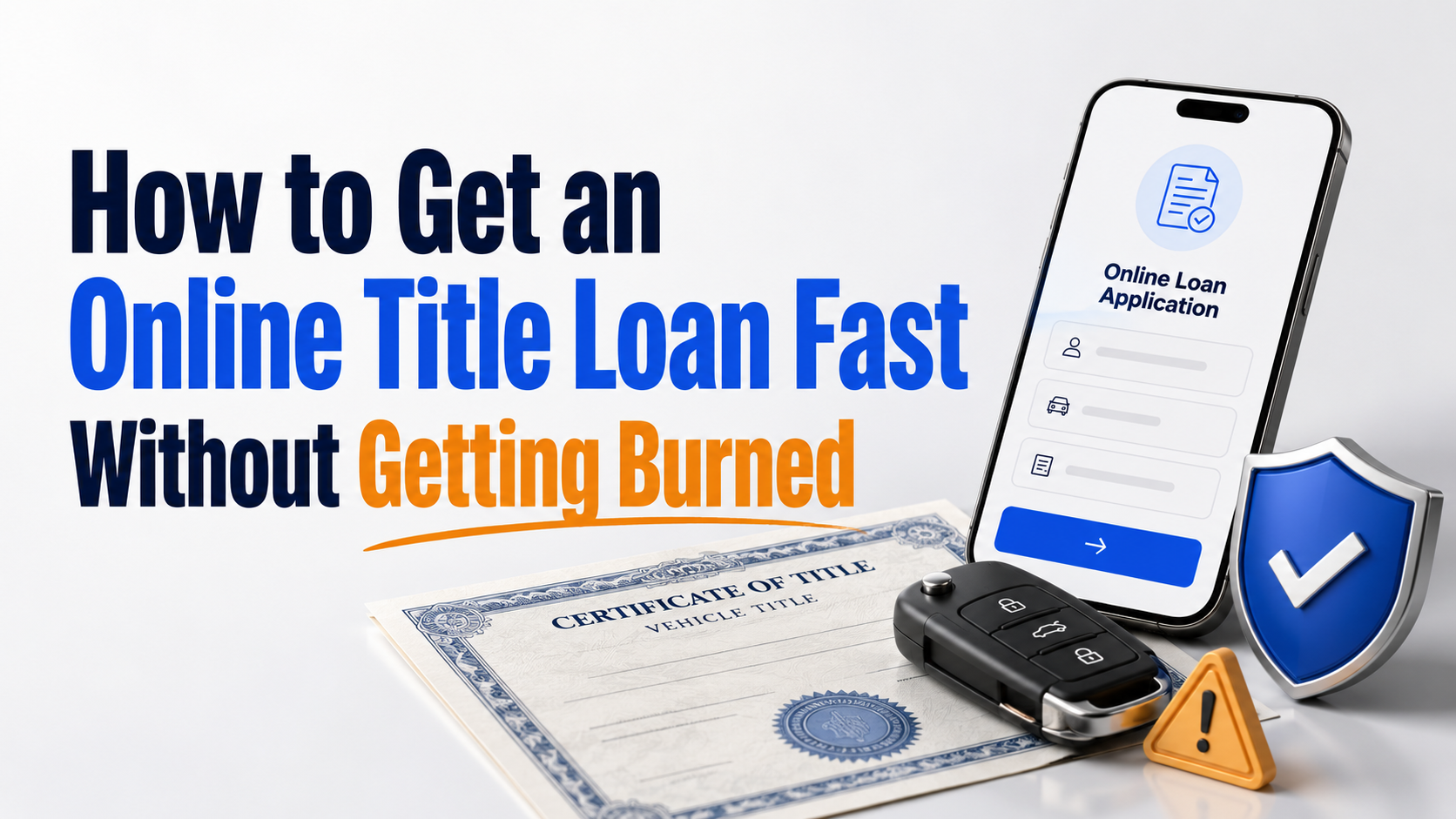
What Are Online Title Loans and How Do They Work?
An online title loan is a title-backed loan you apply for through a website instead of at a storefront. You submit information about yourself and your eligible vehicle, upload documents, and may receive funds electronically if the lender approves you.
The loan is still secured by a title. In most cases, that means the lender takes a claim tied to your vehicle title while the loan is active.
You may be able to keep using the vehicle during repayment, but the title still secures the debt. If you cannot repay, the lender may be able to repossess the vehicle. Consumer.gov explains that title loans are based on vehicle value and may put the vehicle at risk if the borrower cannot repay.
Applying online can reduce the need for an in-person visit, but it does not make the loan safer. You still need to verify the lender, review the repayment terms, compare the total cost, and understand what happens if you miss a payment.
The simple version: an online title loan may make the application easier, but it does not reduce the collateral risk.

Online Title Loan Requirements: What You’ll Need to Apply
An online title loan still requires proof that you own the eligible vehicle and can repay the loan. Having the right documents ready can help prevent delays during the application.
Most online lenders ask for basic information about you, your income, and the vehicle tied to the title. Requirements vary by lender and state, so review the lender’s rules before you apply.
Common documents online title lenders may request
| Requirement | Why It Matters | Speed Tip |
|---|---|---|
| Clear vehicle title | Shows that you own the vehicle and can use the title as collateral | Make sure the title is in your name and check for active liens |
| Government-issued ID | Confirms your identity | Upload a clear, unexpired ID |
| Proof of income | Helps the lender review your ability to repay | Gather recent pay stubs, benefit statements, or bank deposit records |
| Proof of residence | Confirms your current address | Use a recent utility bill, lease, or official mail |
| Vehicle photos | Helps the lender review condition and value online | Take clear photos of the exterior, odometer, VIN, and any requested angles |
| Insurance or registration | May be required by some lenders | Keep current documents ready before applying |
Your title needs to match the loan rules
A title loan depends on ownership. If the title is not in your name, has an active lien, or does not match the lender’s requirements, approval may slow down or stop.
Some lenders may consider vehicles that are nearly paid off, but do not assume that applies everywhere. Ask the lender before submitting sensitive information.
Your credit may not be the main factor
Many title lenders focus more on the vehicle’s value and your ability to repay than on perfect credit. That does not make the loan low-risk.
You still need to review the cost, due date, and default rules before accepting an offer.
Get everything ready before you apply
Prepare your documents before starting the application. Missing photos, unclear scans, expired ID, or title issues can delay approval and funding.
The goal is not just to complete the form. It is to avoid rushing into a loan you do not fully understand.
How Fast Can You Get an Online Title Loan?
Online title loan applications can be convenient, but same-day funding is not guaranteed. The timeline depends on how long the lender takes to verify your title, review your documents, approve the loan, and send the funds.
For many people, the process may take one to two business days. Some lenders may offer a shorter turnaround, but only when the application is complete, the title is clear, and the bank deposit can process without delays.
What can help funding move sooner
You may receive funds sooner if:
- You apply earlier in the business day
- Your title is in your name and free of issues
- Your ID, income proof, and vehicle photos are clear
- Your bank accepts same-day or instant deposits
- The lender can verify your information without follow-up questions
The biggest timing factor is preparation. Missing documents, blurry uploads, or title issues can turn a simple application into a back-and-forth process.
What can delay funding
Funding can take longer if the title has an active lien, your documents do not match, the lender needs more vehicle photos, or you apply after business hours.
Weekends and holidays can also delay deposits. If a lender approves you late on a Friday, the money may not arrive until the next business day.
Be careful with “instant cash” claims
Some lenders use same-day language to make the loan feel guaranteed. Treat that as marketing until you see the actual funding terms.
A trustworthy lender should explain:
- When approval happens
- When funding happens
- Whether instant funding costs extra
- Which bank transfer methods are available
- What could delay the deposit
A short turnaround can help in an emergency, but it should not replace careful review. Before accepting an online title loan, make sure you understand the APR, total repayment amount, due date, and repossession rules.

Online Title Loan Risks and Red Flags
Online title loans can create problems when people focus on approval timing and miss the cost, rollover terms, or repossession rules. Before you apply, look for the risks that can raise the total cost or put your vehicle at risk.
High APRs and fees can make the loan expensive
Title loans often cost much more than traditional loans. The FTC says title loans can charge monthly finance fees as high as 25%, which equals an APR of about 300%.
Look beyond the amount you can borrow. Ask for the APR, finance charge, fees, due date, and total repayment amount before you sign.
Rollovers can keep the debt going
If you cannot repay on time, a lender may offer to roll the loan into a new term. That may delay the due date, but it can also add another round of fees.
The CFPB found that more than four in five single-payment auto title loans were renewed the day they were due because borrowers could not afford to repay them in one payment.
Repossession is the biggest risk
A title loan uses your vehicle title as collateral. That means missed payments can lead to repossession, depending on the contract and state law.
The CFPB also found that one in five borrowers with single-payment auto title loans had their vehicle seized after failing to repay.
If you need the vehicle for work, childcare, school, medical care, or daily life, this risk matters more than the approval speed.
Vague terms are a warning sign
A lender should clearly show the APR, payment schedule, fees, rollover policy, default rules, and repossession process. If those details are hard to find, pause.
Be careful if the lender:
- Does not list a physical address
- Does not show licensing information for your state
- Pushes you to apply immediately
- Avoids showing the APR or total repayment amount
- Promises approval without reviewing ownership, income, or vehicle details
- Charges unclear add-on fees
Poor support can make problems worse
Online lenders should still offer real support. Look for a phone number, support email, business hours, and a clear complaint process.
If you cannot reach someone before you apply, it may be even harder to get help after a missed payment, billing issue, title release delay, or repossession notice.
Bottom line
The biggest red flag is pressure. A legitimate lender should give you time to review the contract, compare the cost, and understand what happens if you cannot repay. A short funding timeline is useful only if the loan terms are clear and the vehicle risk is manageable.

How to Find a Safer Online Title Loan Lender
Not every online title lender gives you the same level of transparency. A safer lender should make the loan terms easy to verify before you submit your title information.
The goal is not to chase the quickest approval. The goal is to find a lender that clearly explains the cost, repayment rules, title requirements, and repossession process before you sign.
Check state licensing first
A legitimate lender should show where it is licensed or authorized to operate. Title loan rules vary by state, so do not assume an online lender can legally lend where you live.
Look for a licensing page, state availability list, or registration details. You can also check your state financial regulator before sharing personal information.
Review the full cost before applying
A safer lender should show the APR, finance charge, fees, due date, and total repayment amount clearly.
If the website only highlights approval timing or the amount you can borrow, slow down. Convenience does not tell you whether the loan is affordable.
Look for clear title and vehicle rules
The lender should explain what type of title it accepts, whether the title must be clear, what documents you need, and whether the vehicle must meet age, mileage, insurance, or registration requirements.
A safer lender verifies ownership and vehicle details. A lender that skips basic checks may still charge high fees, enforce strict default terms, or create problems later.
Make sure support is easy to reach
Online lenders should still provide real customer support. Look for a phone number, email address, business hours, mailing address, and complaint process.
This matters if you need help with payment questions, title release, account errors, hardship options, or payoff instructions.
Avoid lenders that rush the decision
A lender that pressures you to apply immediately is not doing you a favor. A safer lender gives you time to read the contract, compare alternatives, and ask questions.
Walk away if the lender:
- Hides the APR or total repayment amount
- Refuses to explain fees
- Does not show state licensing information
- Uses pressure tactics
- Makes approval sound guaranteed
- Will not provide the agreement in writing
Bottom line
A safer online title loan lender should be transparent, licensed, reachable, and specific about the total cost. If you cannot verify the lender or understand the contract, do not trade your title for convenience.

Faster Alternatives to Online Title Loans
An online title loan may feel like the quickest option, but it is not the only way to cover an urgent expense. Before you use a vehicle title as collateral, compare options that may cost less or carry less risk.
Ask the company you owe for more time
If you need money for rent, utilities, insurance, medical bills, or another specific bill, contact the company first. Ask about a payment plan, due-date extension, hardship program, or temporary pause.
This may solve the immediate problem without adding a high-cost loan.
Check a credit union loan
Credit unions may offer small-dollar loans with lower costs than title loans. Some federal credit unions also offer Payday Alternative Loans, also called PALs.
The NCUA says PALs II loans may be offered for amounts up to $2,000, with terms from one to 12 months.
Compare a personal loan
A personal loan may take longer than an online title loan, but it can offer clearer repayment terms. Some personal loans are unsecured, which means you do not use your vehicle title as collateral.
Even if the rate is not perfect, fixed monthly payments may be easier to manage than a short-term title loan due in one lump sum.
Ask about an employer advance
Some employers offer paycheck advances, earned wage access, emergency grants, or employee assistance funds. These options vary, but they may help you cover a short-term gap without risking your vehicle.
Before using one, ask whether there are fees, repayment deductions, or limits. Even small fees or automatic deductions can affect your next paycheck, so review the terms first.
Look for local emergency assistance
Local nonprofits, religious organizations, community action agencies, and government programs may help with rent, utilities, food, transportation, or medical costs.
This option works best when the need is tied to a specific bill. Call 211 or search local assistance programs in your area to see what is available.
Consider nonprofit credit counseling
If the cash shortage comes from ongoing debt pressure, a nonprofit credit counselor may help you review your budget and repayment options.
Credit counseling is not instant cash. But if the problem is likely to return next month, it may help more than another short-term loan.
Bottom line
The best alternative is the one that solves the immediate need without putting your vehicle at risk. Start with payment extensions, credit unions, personal loans, employer help, and local assistance before you trade your title for convenience.

How to Apply for an Online Title Loan Safely
If you still want to apply for an online title loan, slow the process down enough to protect yourself. A convenient application should still include lender checks, cost review, and a clear repayment plan.
1. Verify the lender before sharing information
Check whether the lender is licensed or authorized to operate in your state. Title loan rules vary by state, and online lenders may not be allowed to lend everywhere.
Look for a physical address, state licensing details, contact information, and a written privacy policy. If you cannot verify the lender, do not submit your title, ID, or bank information.
2. Confirm the total cost
Ask for the APR, finance charge, fees, due date, rollover policy, and total repayment amount before you sign.
Do not rely on the monthly payment or cash amount alone. A small loan can become expensive if the repayment window is short or the fees are high.
3. Review the title and vehicle requirements
Make sure your title, registration, insurance, and vehicle information match the lender’s requirements. If the title has a lien, the name does not match, or the lender needs more photos, approval may slow down.
A legitimate lender should explain what it needs and why.
4. Build the repayment plan before accepting the loan
Know exactly how you will repay the loan by the due date. Do not assume you can roll it over later.
If the payoff amount already feels hard to manage, pause before signing. A rollover may give you more time, but it can also add fees and keep the debt active.
5. Read the contract before signing
The written agreement controls the loan. Read the APR, finance charge, payment schedule, late fees, rollover terms, default rules, repossession policy, and title release process.
If the contract does not match what the lender told you, trust the contract. If the lender will not give you time to read it, walk away.
Bottom line
Applying safely means checking the lender, checking the cost, and checking your repayment plan before you trade convenience for risk. If any part of the loan feels unclear, pause before you sign.
Final Thoughts on Online Title Loans
An online title loan can look convenient when you need money and want to avoid a storefront application. But convenience does not remove the main trade-off: the loan is still secured by your title, and missed payments can put your vehicle at risk.
Before applying, compare safer options first. Ask for a payment plan, check credit union loans, compare personal loans, look for local assistance, or ask about employer support.
If you still move forward, review the lender before you share personal information. Confirm the APR, total repayment amount, due date, rollover policy, and repossession rules in writing.
The goal is not just to get approved. It is to choose an option you can repay without risking your vehicle.

FAQs About Online Title Loans
Can I get an online title loan with bad credit?
Yes, some online title lenders may consider borrowers with bad credit because the loan is secured by a vehicle title. The lender may focus on the title, vehicle value, income, and ability to repay.
That does not make the loan low-risk. You still need to review the full cost, due date, rollover policy, and repossession rules before signing.
How fast can I get approved for an online title loan?
Some lenders may offer quick approval, but funding is not always instant. Approval and deposit timing can depend on document review, title verification, banking hours, and whether the lender needs more information.
Treat same-day funding as a possibility, not a promise. Ask when approval happens, when funds are sent, and whether faster funding costs extra.
Do online title lenders inspect the vehicle in person?
Many online title lenders use digital review instead of an in-person inspection. They may ask for photos of the vehicle, odometer, VIN, registration, title, or insurance.
A lender that skips basic ownership and vehicle checks is not automatically safer or easier. It may still charge high fees or enforce strict default terms.
Can I keep using my vehicle after getting an online title loan?
In many cases, yes. You may keep using the vehicle while the loan is active.
The title still secures the debt. If you miss payments or default, the lender may be able to take action against the vehicle, depending on your contract and state law.
What happens if I miss a payment?
If you miss a payment, the lender may charge late fees, offer a rollover, report the issue where allowed, or move toward repossession. The exact process depends on your contract and state law.
Review the default terms before signing so you know when the vehicle may be at risk and whether you have any option to catch up.
Are online title loans expensive?
They can be. Online title loans may include high finance charges, short repayment timelines, late fees, rollover costs, or other charges.
Before accepting an offer, compare the APR, finance charge, total repayment amount, due date, and rollover costs. The cash you receive today is only one part of the deal.
Are online title loans legal in every state?
No. Title loan rules vary by state, and some states restrict or do not allow certain title lending practices.
Before you apply, check whether the lender is licensed or authorized to operate where you live. A legitimate lender should make state availability and licensing information easy to verify.
What are safer alternatives to an online title loan?
Safer options may include a payment plan with the company you owe, a credit union loan, a personal loan, an employer advance, local emergency assistance, or nonprofit credit counseling.
Start with the option that solves the immediate problem without putting your vehicle at risk. For many borrowers, that means asking for more time, comparing lower-cost credit, or getting help from a local assistance program before using a title-backed loan.

0 Comments