A personal loan can provide a defined amount of money with a predictable repayment schedule. It may help finance a necessary expense, consolidate existing debts, or replace borrowing with less favorable terms.
Approval alone does not make a loan suitable.
The interest rate, fees, repayment period, monthly payment, and reason for borrowing all determine whether a personal loan improves or weakens your financial position. A low monthly payment may conceal a long term. A competitive interest rate may be offset by an origination fee. A fast approval may leave little time to compare alternatives.
This guide explains how personal loans work, the main types available, how lenders evaluate applications, how to compare offers, and when borrowing may not be the right decision.
Key Takeaways
- A personal loan normally provides a lump sum that is repaid through scheduled installments.
- Personal loans may be secured or unsecured, and that distinction affects qualification, pricing, and risk.
- The annual percentage rate provides a broader measure of borrowing cost than the interest rate alone.
- An origination fee may reduce the amount deposited even though the borrower repays the full loan balance.
- Credit history, income, existing debts, loan amount, and lender requirements can all affect approval and pricing.
- Prequalification may help borrowers compare estimated offers, but it is not final approval.
- A lower monthly payment can produce a higher total cost when it extends the repayment period.
- Borrowers should compare the amount received, APR, fees, payment, term, and total repayment before accepting an offer.
- A personal loan should address a defined financial need without making essential monthly expenses unaffordable.
Disclaimer: This site contains affiliate links. If you make a purchase, we may earn a commission at no extra cost to you.
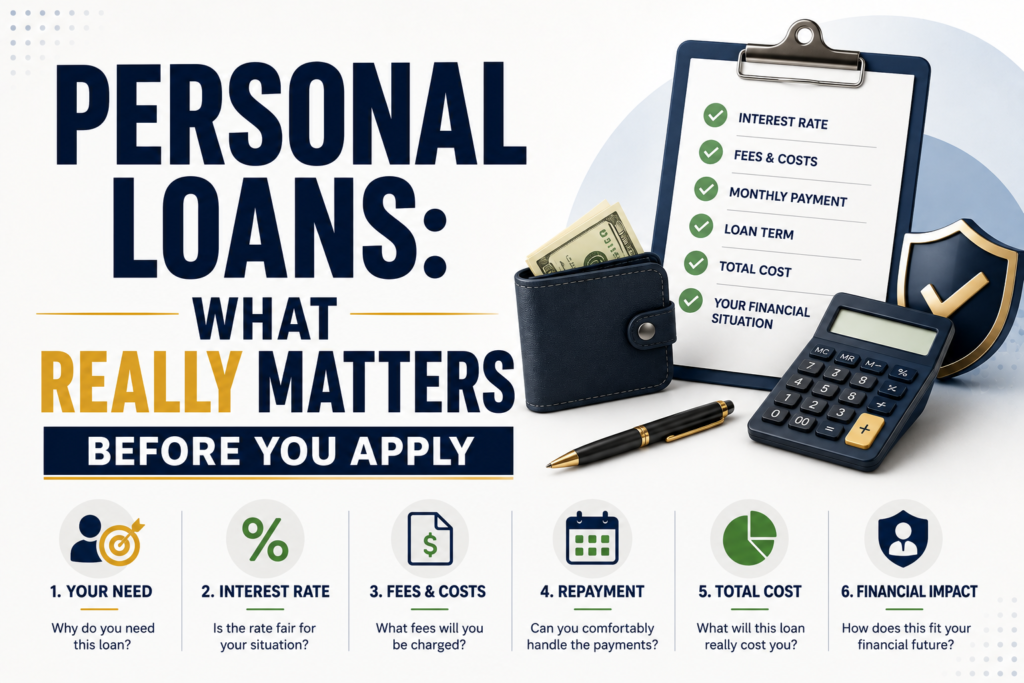
Understanding Personal Loans
A personal loan is generally a form of installment credit.
The borrower receives a specific amount of money and repays it according to an agreed schedule. Payments usually include principal and interest. Depending on the lender and agreement, additional fees may also apply.
Many personal loans have:
- A fixed loan amount
- A defined repayment period
- Regular monthly payments
- A fixed or variable interest rate
- A stated annual percentage rate
- Possible origination, late, or returned-payment fees
Personal loans differ from revolving credit accounts such as credit cards. A credit card allows repeated borrowing up to a credit limit. A personal loan normally provides one disbursement and follows a defined payoff schedule.
The loan may be used for purposes such as:
- Debt consolidation
- Medical expenses
- Home repairs
- Vehicle repairs
- Moving costs
- Major planned purchases
- Other one-time expenses
Lenders may restrict certain uses. The loan agreement and application disclosures should explain any limitations.
Secured and Unsecured Personal Loans
The distinction between secured and unsecured loans affects both borrower risk and lender risk.
Unsecured Personal Loans
An unsecured personal loan does not require the borrower to pledge a specific asset as collateral.
The lender evaluates the application using factors that may include:
- Credit history
- Credit score
- Income
- Employment or income stability
- Existing debt obligations
- Requested loan amount
- Repayment term
- Information submitted during verification
Because no specific asset secures the debt, the lender may apply stricter approval standards or charge a higher rate to borrowers it considers more likely to default.
Failure to repay can still lead to late fees, collection activity, credit reporting, or legal action. “Unsecured” does not mean that repayment is optional or consequence-free.
Secured Personal Loans
A secured personal loan requires collateral.
Possible collateral may include:
- A savings account
- A certificate of deposit
- A qualifying vehicle
- Another asset accepted by the lender
Collateral can reduce the lender’s potential loss. That may improve approval prospects or pricing in some cases.
The trade-off is significant. If the borrower defaults, the lender may be able to take the pledged asset according to the contract and applicable law.
A secured loan should not be selected solely because it is easier to obtain. The borrower must consider whether the financing benefit justifies placing the asset at risk.
Common Personal Loan Categories
Loan labels are not always standardized. Two lenders may use different names for products with similar structures.
The underlying terms matter more than the marketing category.
Debt Consolidation Loans
A debt consolidation loan is a personal loan used to pay several existing debts.
The potential benefits include:
- One scheduled payment
- A defined repayment period
- A possible reduction in interest cost
- A clearer payoff date
Consolidation does not automatically reduce debt.
It may not help when:
- The new APR is not lower
- Origination fees consume the potential savings
- The repayment period is substantially longer
- The borrower continues adding balances to paid-off credit cards
- The new monthly payment does not fit the budget
A valid comparison should examine the remaining cost of the current debts against the full cost of the proposed loan.
Emergency Personal Loans
“Emergency loan” is usually a marketing description rather than a separate legal category.
The product may be a conventional personal loan advertised for quick funding. Speed can be useful when a necessary expense cannot wait, but it should not replace a review of the APR, fees, payment schedule, and alternatives.
Borrowers should distinguish conventional installment loans from payday loans, vehicle title loans, cash advances, and other high-cost short-term products. Similar advertising language does not mean the products have the same structure or risks.
Credit-Builder and Small-Dollar Loans
Some financial institutions offer smaller loans intended to help borrowers establish payment history or meet limited short-term needs.
Federal credit unions may also offer regulated payday alternative loans. The National Credit Union Administration explains that federal credit unions can offer PALs I and PALs II under specific amount, term, fee, and membership requirements. These products are distinct from conventional personal loans and commercial payday loans.
Co-Signed and Joint Loans
Some lenders permit a co-signer or joint applicant.
A co-signer agrees to become responsible for repayment if the primary borrower does not pay. A joint applicant generally applies for and shares responsibility for the debt.
Adding another person may improve qualification in some situations, but it also places that person’s finances and credit at risk.
The parties should understand:
- Who receives the funds
- Who owns the debt
- How payment activity is reported
- What happens after a missed payment
- Whether either person can be removed later

How the Personal Loan Process Works
A personal loan usually moves through prequalification, application, underwriting, disclosure, funding, and repayment.
Prequalification
Some lenders allow prospective borrowers to check estimated eligibility and terms before submitting a full application.
Prequalification may use a soft credit inquiry, which generally does not affect credit scores. However, the borrower should confirm the type of inquiry before providing consent.
A prequalified offer is not a final approval.
Rates and terms may change after the lender verifies:
- Identity
- Income
- Employment
- Credit information
- Existing debts
- Bank account details
- Supporting documents
Formal Application
The formal application may request:
- Personal identification
- Social Security number
- Address history
- Employment information
- Income documents
- Housing payment
- Existing financial obligations
- Requested amount
- Intended loan purpose
- Bank account information
The lender may perform a hard credit inquiry at this stage.
Hard inquiries can affect credit scores, although the effect depends on the individual credit file and scoring model. Borrowers should not assume that inquiries for personal loans will receive the same rate-shopping treatment that some scoring models apply to mortgages, auto loans, or student loans.
Underwriting
Underwriting is the lender’s assessment of whether to approve the application and on what terms.
The lender may evaluate:
- Payment history
- Credit utilization
- Existing loans
- Recent applications
- Income
- Debt-to-income ratio
- Requested amount
- Repayment term
- Internal lending criteria
The Consumer Financial Protection Bureau defines debt-to-income ratio as monthly debt payments divided by gross monthly income. It is one measure lenders may use to evaluate whether a borrower can manage an additional payment.
A lender’s approval standards are not the same as a household affordability test. A borrower may qualify for a loan that leaves too little room for essential expenses.
Verification and Final Offer
Conditional approval may be followed by requests for:
- Pay statements
- Tax forms
- Bank statements
- Benefit letters
- Proof of residence
- Identification
- Collateral records for secured loans
The lender then provides final terms.
The borrower should compare the final agreement with any earlier estimate. Differences may appear in the APR, amount, fee, term, or monthly payment.
Funding
Approved funds may be sent through direct deposit, check, or another method offered by the lender.
Funding speed varies. Advertised same-day or next-day funding usually depends on verification, application timing, bank processing, and other conditions.
Repayment
Repayment generally begins according to the schedule in the agreement.
Payments may be collected through:
- Automatic bank withdrawal
- Online account payment
- Check
- Telephone payment
- Another accepted method
Borrowers should confirm whether automatic payment is optional, whether it changes the rate, and what fees apply after a failed payment.

Interest Rates, APR, and Loan Fees
A personal loan’s cost cannot be evaluated from the monthly payment alone.
The most important figures are the interest rate, APR, finance charge, amount received, repayment period, and total of payments.
Interest Rate
The interest rate determines how interest accrues on the principal.
A fixed rate generally remains unchanged during the loan term. A variable rate may change according to the agreement and its stated index or adjustment method.
Borrowers should confirm whether the rate is fixed or variable before accepting the loan.
Annual Percentage Rate
The APR provides a standardized annual measure of credit cost. It may incorporate certain fees in addition to interest.
The APR is generally more useful than the interest rate alone when comparing loans with similar terms.
However, APR should still be reviewed alongside:
- Loan amount
- Payment
- Term
- Amount received
- Origination fee
- Total repayment
- Prepayment rules
A loan with a lower APR may not be the better choice when it requires borrowing more than necessary or extending repayment substantially longer.
Origination Fees
An origination fee may be charged for processing or establishing the loan.
The lender may:
- Add the fee to the balance
- Charge it separately
- Deduct it from the loan proceeds
Suppose a lender approves a $10,000 loan and deducts a 5% origination fee.
- Approved principal: $10,000
- Origination fee: $500
- Amount deposited: $9,500
- Principal used to calculate repayment: $10,000
The borrower receives $9,500 but may repay principal and interest based on $10,000.
The Federal Trade Commission has previously taken action against a personal-loan platform over advertising that allegedly promised borrowers a specific amount without adequately disclosing an upfront fee deducted from the proceeds.
Other Possible Charges
The agreement may include:
- Late fees
- Returned-payment fees
- Check-processing fees
- Optional insurance
- Membership requirements
- Prepayment penalties
- Collection costs
Not every lender charges each fee.
The borrower should request a complete explanation of all charges before signing.

How Loan Amortization Affects Payments
Most fixed-payment personal loans are amortizing loans.
Each scheduled payment generally includes interest and principal. Early in the schedule, the balance is higher, so more interest may accrue in dollar terms. As the principal declines, the interest portion generally decreases and more of the payment goes toward principal.
This does not necessarily mean that interest has been improperly “front-loaded.”
The precise allocation depends on:
- Interest rate
- Outstanding balance
- Payment timing
- Loan term
- Amortization method
- Additional payments
- Fees
Borrowers should request or review the payment schedule to understand how the balance is expected to decline.
Paying additional principal may reduce future interest on some loans. The agreement should explain how extra payments are applied and whether any prepayment charge exists.
Factors That Influence Qualification and Pricing
No single credit score guarantees approval or a particular APR.
Each lender establishes its own requirements. The following factors commonly influence the decision.
Credit History
Credit reports may show:
- On-time and late payments
- Account balances
- Credit limits
- Collections
- Defaults
- Bankruptcies
- Recent credit applications
- Length and mix of credit history
A score summarizes parts of the credit file, but the lender may review the underlying report as well.
Income
Lenders may consider both the amount and reliability of income.
Possible verification documents include:
- Pay statements
- W-2 forms
- Tax returns
- Bank statements
- Benefit statements
- Business income records
Self-employed, contract, or gig workers may need to provide additional documentation.
Existing Debt
High existing monthly obligations can reduce the amount available for another payment.
To calculate debt-to-income ratio:
Monthly debt payments ÷ gross monthly income × 100
For example, $1,500 in monthly debt payments divided by $5,000 in gross monthly income produces a 30% debt-to-income ratio.
This calculation does not account for taxes, utilities, food, insurance, childcare, and many other household expenses. Borrowers should therefore complete a separate cash-flow review.
Loan Amount and Term
The requested amount and repayment period affect both approval and pricing.
A larger loan creates a larger potential loss for the lender. A longer term keeps the debt active longer and can increase the total interest paid.
Borrowers should request only the amount required for the defined purpose.
Collateral or Additional Applicants
Collateral, a co-signer, or a joint applicant may affect approval.
These options transfer risk rather than eliminate it. The asset owner or additional borrower can face serious consequences if payments are missed.
Sources of Personal Loans
The lender category can affect rates, fees, underwriting, service, and funding speed.
No category is automatically the best for every borrower.
Banks
Banks may offer personal loans to existing and new customers.
Potential advantages include:
- Established servicing systems
- Relationship discounts
- Branch access
- Larger loan options
Possible limitations include stricter underwriting or limited products for borrowers with weaker credit profiles.
Credit Unions
Credit unions are member-owned institutions. Membership eligibility applies.
Federal credit unions are subject to an interest-rate ceiling set by the National Credit Union Administration. The NCUA has also established separate rules for payday alternative loans.
A credit union may be worth considering when the borrower values personal service, smaller loan amounts, or an existing banking relationship.
That does not guarantee approval or the lowest available rate.
Online Lenders
Online lenders can offer:
- Digital applications
- Prequalification
- Automated verification
- Rapid decisions
- Electronic funding
Borrowers should verify the lender’s identity, state licensing, contact information, privacy practices, and complete loan terms.
Speed should not be treated as evidence of value or legitimacy.
Peer-to-Peer and Marketplace Platforms
Some online platforms connect applicants with partner lenders or investors rather than funding every loan directly.
The borrower should identify:
- Which company is making the loan
- Which company services it
- What fees the platform charges
- Whether information is shared with several providers
- Whether the displayed terms are final
Cash-Advance Apps
Cash-advance and earned-wage products are not necessarily conventional personal loans.
They may use subscription fees, expedited-transfer charges, optional tips, or automatic account withdrawals. Borrowers should calculate the dollar cost and repayment timing rather than assume that a product is inexpensive because it does not advertise a conventional interest rate.

How to Compare Personal Loan Offers
A reliable comparison uses the same criteria for every offer.
| Factor | What to Compare |
| Principal | The amount on which repayment is based |
| Net proceeds | The amount deposited after deducted fees |
| Interest rate | Fixed or variable |
| APR | Annualized borrowing cost |
| Origination fee | Amount and method of collection |
| Monthly payment | Required amount and due date |
| Loan term | Number of months or years |
| Total of payments | Full scheduled repayment |
| Late fees | Amount and triggering conditions |
| Prepayment | Whether early payoff is permitted without a charge |
| Autopay | Whether it is optional and affects pricing |
| Collateral | Asset placed at risk |
| Credit reporting | Which payment activity may be reported |
| Hardship support | Available options after financial difficulty |
Compare Net Proceeds
A loan’s face amount may differ from the amount the borrower receives.
When fees are deducted, determine whether the remaining proceeds are sufficient for the intended expense.
Do not borrow additional money solely to offset a large fee without calculating the increased repayment cost.
Compare Total Repayment
A longer term can reduce the monthly payment while increasing the total interest paid.
Consider two hypothetical offers for $10,000:
| Offer | APR | Term | Approximate Monthly Payment | Approximate Total Repayment |
| A | 12% | 36 months | $332 | $11,957 |
| B | 10% | 60 months | $212 | $12,748 |
Offer B has a lower APR and payment but a higher approximate total repayment because the debt remains active longer.
The figures are illustrative and exclude fees.
Compare Affordability
The shortest term usually reduces total interest, but it also creates a higher required payment.
The appropriate term is not automatically the shortest available. It is the shortest term whose payment can be made consistently without sacrificing essential expenses or relying on additional debt.
Compare the Final Agreement
A prequalified estimate may change after verification.
Before signing, confirm that the final documents match the expected:
- Principal
- Net proceeds
- APR
- Fee
- Payment
- Term
- Total repayment
- Collateral requirements
Do not rely on an advertisement, calculator, or approval email when the final agreement says something different.

Common Personal Loan Mistakes
Accepting the First Offer
One approval does not establish the market value of the applicant’s credit profile.
Prequalifying with several legitimate lenders may reveal differences in rates, fees, terms, and proceeds.
Focusing Only on the Payment
A low payment may result from a long repayment period.
Compare the total repayment and the date when the debt will end.
Ignoring Deducted Fees
An origination fee can leave the borrower with less cash than expected.
Compare the approved amount with the actual proceeds.
Borrowing More Than Necessary
An available credit amount is not a recommended borrowing amount.
Every additional dollar can increase the payment and total interest.
Misunderstanding Prequalification
Prequalification is an estimate, not a binding final offer.
Do not commit the money to an expense until funding and final terms have been confirmed.
Submitting Too Many Full Applications
Each formal application may produce a hard inquiry.
Use prequalification when available, confirm the inquiry type, and submit a full application only after narrowing the options.
Using a Loan for an Ongoing Shortfall
A personal loan may fund a one-time expense. It is less likely to help when recurring income consistently falls below recurring expenses.
In that situation, the new payment can deepen the monthly deficit.
Paying an Advance Fee for a Promised Loan
A legitimate loan may include disclosed fees, but a demand to pay money before receiving a promised loan can indicate fraud.
The FTC warns that companies guaranteeing credit while demanding an upfront “processing” or similar payment may be operating an advance-fee loan scam.

Appropriate and Inappropriate Uses
A personal loan is a financing tool. Its suitability depends on the purpose, terms, and repayment capacity.
Situations Where a Personal Loan May Be Reasonable
A loan may be worth evaluating when:
- The expense is necessary and clearly defined
- The amount required is known
- The payment fits the budget
- The borrower understands the full cost
- The loan replaces higher-cost debt
- The repayment term matches the useful purpose
- Less costly resources are unavailable
Situations That Require More Caution
A personal loan may not resolve the problem when:
- It covers recurring living expenses
- The borrower needs another loan to make the payment
- The amount is being used for speculative investing
- The loan funds discretionary spending that cannot be afforded
- Consolidated credit cards will immediately be used again
- The payment leaves no emergency margin
- Collateral essential to work or daily life is at risk
- The total cost is unclear
The right question is not simply whether the lender will approve the application.
It is whether the loan produces a more stable financial position after the money is spent.
Steps to Take Before Applying
1. Define the Purpose
Write down:
- The exact expense
- The amount required
- The payment deadline
- Whether the expense can be reduced
- Whether a payment plan is available
2. Review Monthly Cash Flow
Calculate take-home income and subtract:
- Housing
- Food
- Utilities
- Transportation
- Insurance
- Healthcare
- Childcare
- Existing debt payments
- Other essential obligations
Determine the payment that can be sustained without depending on new credit.
3. Check Credit Reports
Review credit reports for inaccurate or unfamiliar information before applying.
Correcting legitimate errors may take time, so this should not be left until the funding deadline.
4. Compare Alternatives
Depending on the need, alternatives may include:
- A creditor payment plan
- Savings
- A credit-union loan
- Employer assistance
- Community assistance
- A medical payment arrangement
- A secured loan with carefully evaluated collateral risk
- Delaying or reducing the expense
5. Prequalify Where Appropriate
Use legitimate lenders that clearly explain whether prequalification involves a soft or hard inquiry.
Record each estimated:
- APR
- Fee
- Payment
- Term
- Net proceeds
6. Verify the Lender
Check:
- Legal business name
- Physical address
- State licensing
- Privacy policy
- Customer service information
- Complaint procedures
- Website security
7. Read the Final Agreement
Do not sign until the agreement clearly states:
- Amount financed
- Amount received
- APR
- Finance charge
- Payment schedule
- Total of payments
- Fees
- Default consequences
- Prepayment terms
- Collateral terms, when applicable
Conclusion
A personal loan can simplify repayment, cover a necessary expense, or replace more expensive debt. It can also add years of payments and significant borrowing costs when the terms are misunderstood.
The most important figure is not the approval amount.
A sound decision considers the amount actually received, APR, fees, monthly payment, repayment period, total cost, and effect on the household budget.
Compare final offers using the same criteria. Borrow only what is necessary. Confirm that the payment fits after essential expenses. Read the agreement before authorizing funding.
A suitable personal loan should solve a defined financial problem without creating a larger one.
Frequently Asked Questions
What Is a Personal Loan?
A personal loan normally provides a lump sum that is repaid through scheduled installments. The loan may be secured by collateral or unsecured.
What Credit Score Is Needed for a Personal Loan?
There is no universal minimum score. Requirements vary by lender, loan type, amount, income, existing debt, and other application information.
Does Prequalification Affect Credit Scores?
Prequalification often uses a soft inquiry, but practices vary. Confirm the inquiry type with the lender before submitting information.
Does a Formal Application Affect Credit Scores?
A formal application commonly produces a hard inquiry, which may affect credit scores. The effect depends on the credit file and scoring model.
Can a Personal Loan Be Used for Debt Consolidation?
Yes. It may consolidate several debts into one payment. The strategy is most useful when the new loan provides a manageable payment and favorable total cost and the borrower avoids rebuilding the previous balances.
Is a Secured Personal Loan Better Than an Unsecured Loan?
Neither is universally better. A secured loan may offer improved terms but places the collateral at risk. An unsecured loan avoids that specific asset risk but may have stricter qualification standards or a higher cost.
Can a Personal Loan Be Repaid Early?
Many lenders permit early repayment. Review the agreement for prepayment penalties and confirm how extra payments are applied.
How Quickly Are Personal Loans Funded?
Funding can range from the same business day to several days or longer. Timing depends on the lender, verification, banking schedules, and application details.
What Happens After a Missed Payment?
Possible consequences include late fees, collection contact, negative credit reporting, default, or legal action. Secured loans may also place the collateral at risk. Contact the lender promptly when a payment problem appears likely.
Is APR More Important Than the Interest Rate?
APR is generally more useful for comparing borrowing costs because it may include certain fees. It should still be considered alongside the term, payment, amount received, and total repayment.
Are Personal Loans Better Than Credit Cards?
It depends on the terms and intended use. A personal loan provides a defined payment schedule. A credit card offers revolving access. Compare APR, fees, repayment flexibility, and total expected cost.
When Is a Personal Loan a Bad Idea?
It may be unsuitable when it funds recurring expenses, creates an unaffordable payment, places an essential asset at risk, or does not improve the cost or structure of existing debt.

5 Comments
Personal Loan for Self-Employed: How to Get Approved Fast - Look Up Loans · April 26, 2025 at 2:51 am
[…] Get the full breakdown on how personal loans work — read our personal loan guide here. […]
Personal Loan vs Line of Credit: Which Is Right for You - Look Up Loans · October 8, 2025 at 2:11 pm
[…] over a set term, usually 1 to 7 years. This fixed structure is why financial planners often suggest personal loans for borrowers who prefer predictable budgeting and clear timelines. The interest rate and payment […]
How a Personal Line of Credit Really Works (And When It’s a Bad Idea) - Look Up Loans · October 8, 2025 at 4:27 pm
[…] personal loans, you’re not forced to take out the full amount at once. That’s ideal if you expect ongoing […]
Personal Loan vs Credit Card: Which Is Better for You - Look Up Loans · October 17, 2025 at 2:24 am
[…] Personal loans win for predictable payments and structured payoff schedules ideal for disciplined debt management. […]
Personal Loan vs Auto Loan: Choose the Right Option - Look Up Loans · October 20, 2025 at 12:51 pm
[…] Personal loans are unsecured, meaning they don’t require you to offer up the car or any other asset as collateral. This makes them more flexible, you can use the funds for the vehicle, repairs, registration, or anything else. But because there’s no collateral, lenders take on more risk, and that usually means higher interest rates and stricter credit requirements. […]