Introduction
Choosing between a secured loan and an unsecured loan comes down to one central trade-off: collateral may improve your borrowing options, but it also puts an asset at risk.
A secured loan is backed by property, savings, or another asset accepted by the lender. That collateral may support a larger loan amount, broader approval possibilities, or more competitive terms. If you default, however, the lender may be able to claim the pledged asset.
An unsecured loan does not require collateral. Approval depends more heavily on your credit history, income, existing debts, and ability to repay. The process may be simpler, but available rates and loan amounts can be less favorable, particularly when credit is limited or damaged.
Neither option is automatically better.
This guide compares secured and unsecured loans across approval, cost, repayment, funding speed, and risk so you can determine which structure better fits your needs.
Key Takeaways
- Secured loans require collateral, such as a home, vehicle, savings account, or another asset accepted by the lender.
- Unsecured loans do not require a pledged asset, but approval generally depends more heavily on credit, income, and existing debt.
- Collateral may support better terms, but it does not guarantee approval, a lower rate, or an affordable payment.
- Defaulting on a secured loan may result in the loss of the collateral.
- Defaulting on an unsecured loan can still lead to credit damage, collections, and possible legal action.
- Secured loans may take longer to process when the lender must evaluate, insure, or record a claim against the asset.
- The better option depends on the loan purpose, full cost, repayment terms, timeline, and consequences of default.
Disclosure: This site may contain affiliate links. We may receive compensation if you use certain links, at no additional cost to you. Compensation does not determine our editorial conclusions.
Secured vs. Unsecured Loans: What They Are
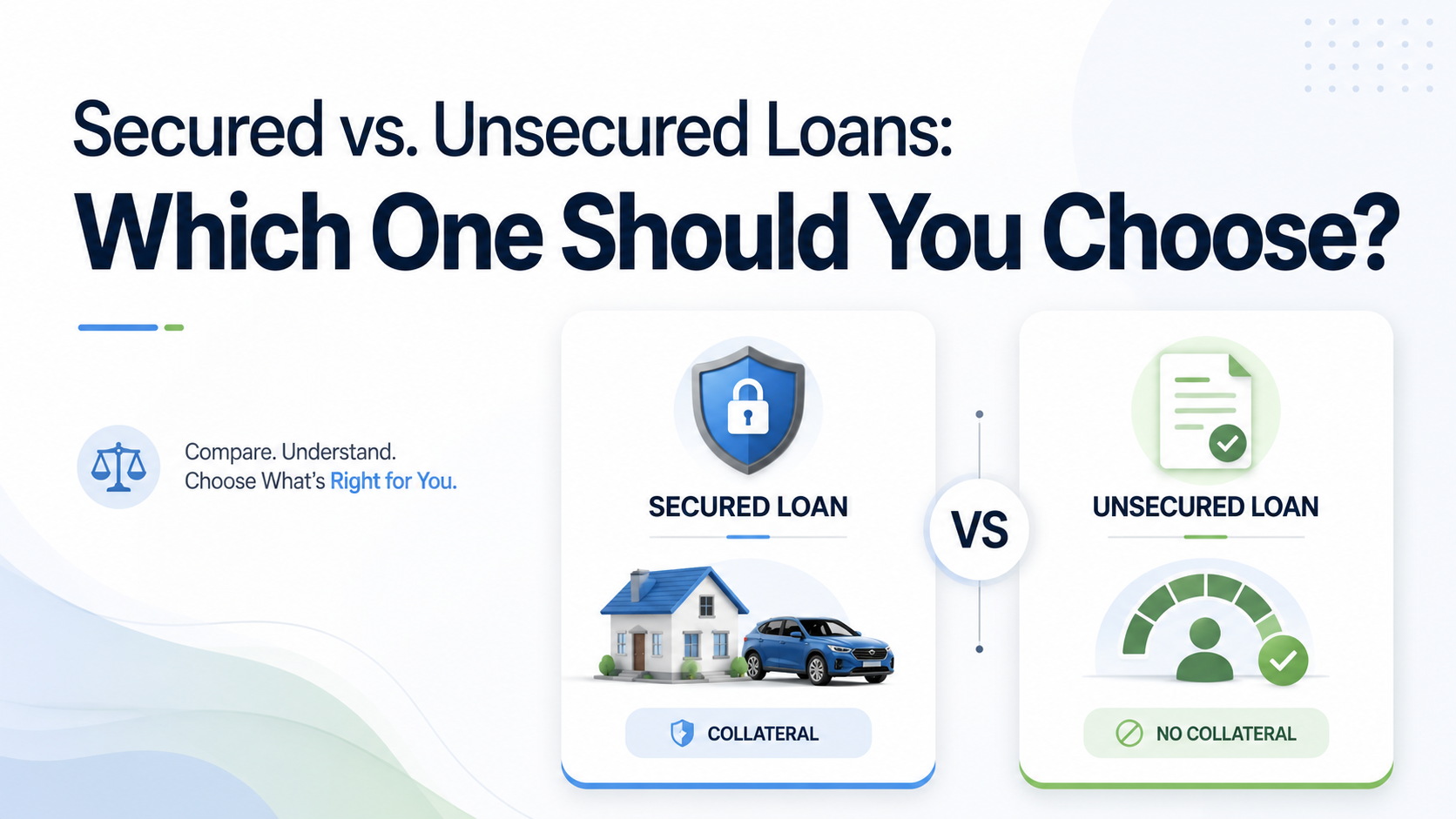
The main difference between secured and unsecured loans is collateral.
A secured loan is backed by an asset that the lender may claim if the borrower does not repay according to the agreement. The Consumer Financial Protection Bureau explains the distinction between secured and unsecured loans through the role collateral plays in the credit agreement.
Common secured loans include:
- Mortgages
- Auto loans
- Home equity loans
- Secured personal loans
- Secured business loans
- Title loans
Secured borrowing also includes related credit products. A secured credit card, for example, is revolving credit backed by a cash deposit rather than an installment loan.
An unsecured loan is not tied to a specific asset.
The lender instead evaluates the borrower’s financial profile, which may include:
- Credit history
- Income
- Existing debts
- Payment history
- Employment or income stability
- Requested loan amount
- Ability to repay
Common unsecured products include:
- Unsecured personal loans
- Most credit cards
- Some personal lines of credit
- Many student loans
- Certain medical financing products
An unsecured lender does not have an automatic claim against a specific home, vehicle, or savings account. Default can still lead to fees, negative credit reporting, collections, and legal action.

How Secured and Unsecured Loans Differ
Collateral affects more than the consequences of default. It can also influence approval, pricing, loan size, processing time, and documentation.
| Factor | Secured Loans | Unsecured Loans |
|---|---|---|
| Collateral | Required | Not required |
| Common examples | Mortgages, auto loans, home equity loans, secured personal loans | Unsecured personal loans, most credit cards, some credit lines |
| Approval review | Credit, income, debt, documentation, and collateral | Credit, income, debt, and repayment history |
| Potential loan size | May be higher when valuable collateral supports the debt | Depends more directly on credit and income |
| Potential rate | May be lower for qualified borrowers and certain products | May be higher because no asset secures the debt |
| Processing | May require appraisal, title review, lien filing, or account verification | Usually avoids collateral-related steps |
| Primary risk | Loss of collateral, credit damage, and possible remaining debt | Credit damage, collections, and possible legal action |
| Typical use | Asset purchases, larger borrowing needs, or financing supported by suitable collateral | Personal borrowing without pledging an asset |
These are general differences, not guaranteed outcomes.
A secured loan can still be expensive. A title loan, for example, may carry high charges despite being backed by a vehicle.
An unsecured loan can also offer competitive terms when the borrower has strong credit, stable income, and manageable existing debt.
The specific agreement matters more than the product label alone.
Approval
A secured lender evaluates both the borrower and the asset.
The lender may review:
- Credit history
- Income
- Existing obligations
- Collateral ownership
- Collateral value
- Existing liens
- Insurance
- Supporting documents
An unsecured lender does not need to evaluate an asset, so approval relies more heavily on the borrower’s financial qualifications.
Collateral may strengthen an application, but it does not guarantee approval. A lender may still decline the loan because income is insufficient, existing debts are too high, the asset has limited value, or ownership cannot be verified.
Interest Rates and Fees
Some secured loans may offer lower rates because collateral reduces part of the lender’s risk.
That benefit is not universal.
Pricing also depends on:
- Credit profile
- Income
- Loan amount
- Repayment term
- Product type
- Market conditions
- Lender fees
Secured loans may include collateral-related costs such as appraisal, title, lien-recording, closing, insurance, or account fees.
Unsecured loans may include origination, documentation, late-payment, or other charges.
The interest rate alone does not show the complete borrowing cost. The CFPB explains that APR includes the interest rate and additional loan fees, making it a useful comparison measure.
Loan Amounts
Collateral may support a larger loan when the asset has sufficient value.
This is one reason mortgages, home equity products, auto loans, and secured business loans can finance substantial purchases or expenses.
Unsecured borrowing limits depend more directly on credit, income, and existing debt.
A larger approval is not automatically better. The appropriate amount is the smallest loan that meets the need while keeping repayment manageable.
Funding Speed
Unsecured loans may be processed faster when no collateral review is required.
Secured financing may involve additional steps such as:
- Property appraisal
- Vehicle valuation
- Title review
- Lien filing
- Insurance verification
- Savings-account restriction
- Business asset documentation
The exact timeline depends on the product. A mortgage may take considerably longer than a savings-secured loan, even though both are secured.
Benefits, Drawbacks, and Trade-Offs
The choice is not simply between collateral and no collateral. Each structure shifts cost, access, convenience, and risk differently.
Secured Loans
A secured loan may provide:
- More competitive potential rates
- Larger possible loan amounts
- Broader approval possibilities
- Longer repayment options
- Financing designed for major assets such as homes or vehicles
The drawbacks may include:
- Loss of the pledged asset after default
- Additional collateral documentation
- Appraisal, title, lien, or closing costs
- Longer processing times
- Greater consequences when essential property is involved
A secured loan may be appropriate when the collateral materially improves the available terms and the borrower can manage the payment and asset risk.
It becomes more dangerous when the collateral is essential, the budget is already tight, or the loan only postpones a recurring financial shortfall.
Unsecured Loans
An unsecured loan may provide:
- No direct claim against a pledged asset
- A simpler application
- Faster potential funding
- Flexible use of proceeds
- Less collateral-related documentation
The drawbacks may include:
- Higher potential rates
- Greater dependence on credit and income
- Lower borrowing limits
- Stricter qualification standards
- Credit and collection consequences after default
An unsecured loan may be preferable when the borrower qualifies for reasonable terms without placing property or savings at risk.
It may be unsuitable when the rate, fees, or monthly payment make the debt difficult to repay.
The Central Trade-Off
A secured loan may exchange asset risk for improved borrowing terms.
An unsecured loan may avoid asset risk while requiring stronger financial qualifications or a higher borrowing cost.
The right comparison is not:
Which loan is generally better?
It is:
Which loan offers an affordable total cost with consequences I can manage?

When to Choose a Secured vs. Unsecured Loan
The loan structure should match the borrowing purpose, repayment capacity, and level of risk involved.
Choose a Secured Loan If
A secured loan may make sense when:
- You are financing an asset that normally secures the debt, such as a home or vehicle.
- You need a larger loan amount.
- Collateral materially improves the available terms.
- The payment fits comfortably within your budget.
- You understand how and when the lender may act against the asset.
- The collateral is appropriate for the loan’s purpose.
- The total cost compares favorably with other options.
Examples may include:
- A mortgage for an affordable home
- An auto loan for reliable transportation
- A savings-secured loan used to establish credit
- A secured business loan supported by appropriate business assets
The loan, collateral, purpose, and repayment plan should make sense together.
Choose an Unsecured Loan If
An unsecured loan may be more appropriate when:
- You qualify for reasonable terms without collateral.
- You do not want to expose a home, vehicle, savings, or another asset.
- The borrowing need is relatively modest.
- A simpler application matters.
- The payment fits your budget.
- The total cost remains competitive after fees.
Unsecured loans may be considered for debt consolidation, repairs, medical costs, planned purchases, or other personal expenses.
The intended use does not make the loan appropriate by itself. The APR, fees, payment, and repayment period must still be manageable.
Consider Neither Option Yet If
Waiting or pursuing another solution may be better when:
- The payment already feels difficult.
- The loan purpose is unclear.
- Regular expenses exceed regular income.
- The new debt would be used to make payments on other debts.
- The total cost is excessive.
- The lender pressures you to act quickly.
- Important terms are unclear.
- The loan only postpones a recurring cash-flow problem.
A creditor payment arrangement, hardship program, smaller loan, reduced expense, or assistance program may address the need with less risk.

What to Expect When Applying
Both loan types require the lender to evaluate whether the borrower appears able to repay. A secured application also requires the lender to review the collateral.
Secured Loan Applications
A secured lender may request:
- Government-issued identification
- Proof of income
- Credit and debt information
- Ownership or title records
- Appraisal or valuation documents
- Insurance information
- Details about existing liens
The requirements depend on the asset.
A mortgage may require a property appraisal. An auto loan may require title and insurance information. A savings-secured loan may require verification and restriction of the pledged account.
Unsecured Loan Applications
An unsecured lender may request:
- Government-issued identification
- Proof of income
- Employment or income verification
- Credit and debt information
- Bank details for funding and payments
Because no asset must be evaluated, the process may involve fewer steps.
The lender may compensate for the lack of collateral by placing more weight on credit history, income stability, and existing obligations.
Before Submitting an Application
Prepare the required documents and confirm:
- Whether checking rates uses a hard or soft credit inquiry
- The APR and applicable fees
- The expected monthly payment
- The repayment term
- The funding timeline
- Any collateral requirements
- The consequences of default
Avoid submitting several full applications before understanding how each lender checks credit.

What to Compare Before Choosing
Use the same comparison criteria for every secured and unsecured offer.
| Factor | What to Review |
|---|---|
| Loan purpose | Whether the product fits the borrowing need |
| Collateral | Which asset is at risk, if any |
| Loan proceeds | The amount you will actually receive |
| APR | The annualized cost of credit |
| Fees | Origination, appraisal, title, closing, or account charges |
| Monthly payment | Whether it fits actual cash flow |
| Repayment term | How long the debt will remain active |
| Total repayment | The full amount expected over the term |
| Rate structure | Whether the rate is fixed or variable |
| Funding timeline | Whether the money will arrive when needed |
| Prepayment terms | Whether early payoff is allowed or penalized |
| Default terms | What happens after missed payments |
| Credit reporting | Whether account activity is reported |
| Collateral release | How and when a lien, deposit, or claim is released |
Do not compare only the monthly payment.
A lower payment may result from a longer term, which can increase total interest.
Do not compare only the advertised rate.
A competitive rate may be offset by origination fees, closing costs, appraisal charges, or other expenses.
Do not compare only funding speed.
Fast access to money does not establish that the loan is affordable.
The strongest offer solves the borrowing need at a reasonable total cost, with risks you understand and can manage.
Secured Vs Unsecured Loan: What Happens If You Default?
Default can lead to serious consequences with either loan type.
The main difference is that a secured lender has rights against a specific pledged asset. An unsecured lender does not have an automatic claim against particular property.
Defaulting on a Secured Loan
If you default on a secured loan, the lender may eventually act against the collateral.
Depending on the loan, that may involve:
- Repossessing a vehicle
- Beginning foreclosure on a home
- Freezing or claiming pledged savings
- Taking business equipment or other secured property
- Applying a secured-card deposit to the unpaid balance
The lender may sell the collateral and use the proceeds to reduce the debt.
Losing the asset does not always eliminate the full balance. If the sale proceeds do not cover the unpaid debt and permitted expenses, you may still owe a deficiency balance.
The Consumer Financial Protection Bureau explains that a borrower may still owe money after vehicle repossession when the sale price does not cover the remaining loan balance and applicable costs.
Defaulting on an Unsecured Loan
An unsecured lender cannot immediately repossess a specific home, vehicle, or savings account because no asset was pledged to secure the debt.
The lender may still:
- Charge late fees
- Report missed payments
- Restrict or close the account
- Send or sell the debt to collections
- File a lawsuit where permitted
- Seek post-judgment collection remedies
An unsecured loan therefore avoids direct collateral risk, but it does not remove credit, collection, or legal consequences.
The Federal Trade Commission explains that covered debt collectors may not use abusive, unfair, or deceptive practices when attempting to collect consumer debts.
The Practical Difference
| After Default | Secured Loan | Unsecured Loan |
|---|---|---|
| Specific asset at risk | Yes | No pledged asset |
| Credit damage possible | Yes | Yes |
| Collection activity possible | Yes | Yes |
| Legal action possible | Yes | Yes |
| Remaining balance possible | Yes | Yes |
| Repossession or foreclosure | Possible | Not based on a pledged asset |
A secured loan exposes both your credit and the collateral.
An unsecured loan primarily exposes your credit and finances, although legal action may create additional consequences.
Contact the lender as soon as repayment becomes uncertain. A due-date change, temporary payment arrangement, or hardship option may be available, although assistance is not guaranteed.
Conclusion
Secured and unsecured loans distribute risk differently.
A secured loan may support a larger amount, broader approval possibilities, or more competitive pricing. The lender receives a claim against collateral, which means repayment failure can place a home, vehicle, savings account, or another asset at risk.
An unsecured loan avoids that direct asset exposure. Approval may depend more heavily on credit, income, and existing obligations, and the available terms may be less favorable.
The right choice depends on more than the loan category.
Compare the APR, fees, payment, term, total repayment amount, funding timeline, and default consequences. For a secured loan, also consider what losing the collateral would mean in practical terms.
Choose the structure that meets the financial need without creating a greater risk than the problem it is meant to solve.
Frequently Asked Questions
What Is the Main Difference Between Secured and Unsecured Loans?
A secured loan requires collateral. An unsecured loan does not pledge a specific asset and depends more heavily on the borrower’s financial qualifications.
Is a Secured Loan Better Than an Unsecured Loan?
Not automatically. A secured loan may offer stronger terms but places an asset at risk. An unsecured loan avoids collateral risk but may cost more or require stronger credit.
Does Collateral Guarantee a Lower Interest Rate?
No. Collateral may reduce lender risk, but rates also depend on the product, borrower, repayment term, fees, and market conditions.
Are Secured Loans Easier to Qualify For?
They may provide broader approval possibilities in some cases, but approval is not guaranteed. Lenders still review income, debt, credit, documentation, and collateral value.
Which Option Is Better for Debt Consolidation?
Either structure may be used. An unsecured consolidation loan avoids placing an asset at risk. A secured option may offer different terms but can convert unsecured debt into debt backed by property or savings.
Can an Unsecured Loan Later Become Secured?
A borrower may refinance or replace unsecured debt with secured financing when a lender offers that option. Doing so adds collateral risk and should be evaluated carefully.
Does Checking Loan Rates Affect Credit?
It depends on the lender. A soft inquiry generally does not affect credit scores, while a hard inquiry may. Confirm the inquiry type before completing an application.
Which Loan Type Is Usually Faster?
Unsecured loans may process faster because the lender does not need to value or verify collateral. Actual funding times vary by lender and product.
Do Both Loan Types Affect Credit?
They can. Payment activity may be reported for either type. Missed payments and defaults can damage credit whether or not collateral is involved.
Is an Unsecured Loan Risk-Free?
No. It avoids direct collateral risk, but missed payments can still lead to fees, credit damage, collections, and possible legal action.
Can a Co-Signer Replace Collateral?
A co-signer and collateral serve different purposes. Some lenders may accept a co-signer on an unsecured loan, but that does not make the loan secured.
When Should You Avoid Both Options?
Consider waiting when the payment is unaffordable, the purpose is unclear, the total cost is excessive, or the new debt only postpones a recurring cash-flow problem.

5 Comments
Unsecured Loans: Everything You Need to Know in 2025 - Look Up Loans · March 15, 2025 at 2:23 am
[…] Next check out our Secured vs. Unsecured Loans: A Comparison Guide. […]
Personal Loan vs Auto Loan: How to Choose the Right Option - Look Up Loans · March 25, 2025 at 2:56 am
[…] still weighing your options and want to learn more about how secured loans compare, check out our secured vs unsecured personal loan guide. It’s a great next step if you’re trying to better understand which type of loan aligns with […]
Secured Personal Loans: How to Choose the Right Option - Look Up Loans · March 31, 2025 at 1:42 am
[…] Next, check out our Secured vs. Unsecured Loans Guide. […]
Personal Loans: Read This Before You Sign Anything - Look Up Loans · April 22, 2025 at 5:46 pm
[…] To learn more check out our Secured vs. Unsecured Loans Comparison. […]
Secured Loans: What They Are and How They Work - Look Up Loans · August 31, 2025 at 12:56 pm
[…] ⇒ For the full Secured vs. Unsecured Loans Breakdown. […]